
Real estate VA CRM management is the systematic practice of delegating full pipeline ownership – including lead intake, contact segmentation, drip sequence enrollment, stage progression tracking, database hygiene, and behavioral trigger monitoring – to a trained real estate virtual assistant who maintains CRM accuracy and follow-up velocity independently of the agent’s availability. The operational case is data-driven: research from MIT cited by Inside Real Estate found that leads contacted within five minutes are up to 100 times more likely to convert than those contacted after 30 minutes – yet the average agent takes over 15 hours to respond to a new inquiry. A dedicated REVA eliminates that response gap by owning the CRM workflow continuously, ensuring no contact goes untouched, no follow-up sequence lapses, and no high-intent lead disappears into a stale database.
That 15-hour average response gap is not a technology problem. It is a bandwidth problem. Most agents know their CRM is underperforming. They simply do not have the capacity to maintain it while simultaneously handling showings, offers, client calls, and listing appointments.
This article breaks down exactly how a trained real estate VA takes full ownership of your CRM: the specific tasks, the daily workflows, the platform-level practices, and the performance benchmarks that turn a neglected database into a lead conversion engine.
If your CRM is currently a contact graveyard rather than a revenue system, the most direct path to fixing that is working with a team built for this: explore dedicated real estate virtual assistant support from RLIVO, specifically structured around pipeline management and lead operations.
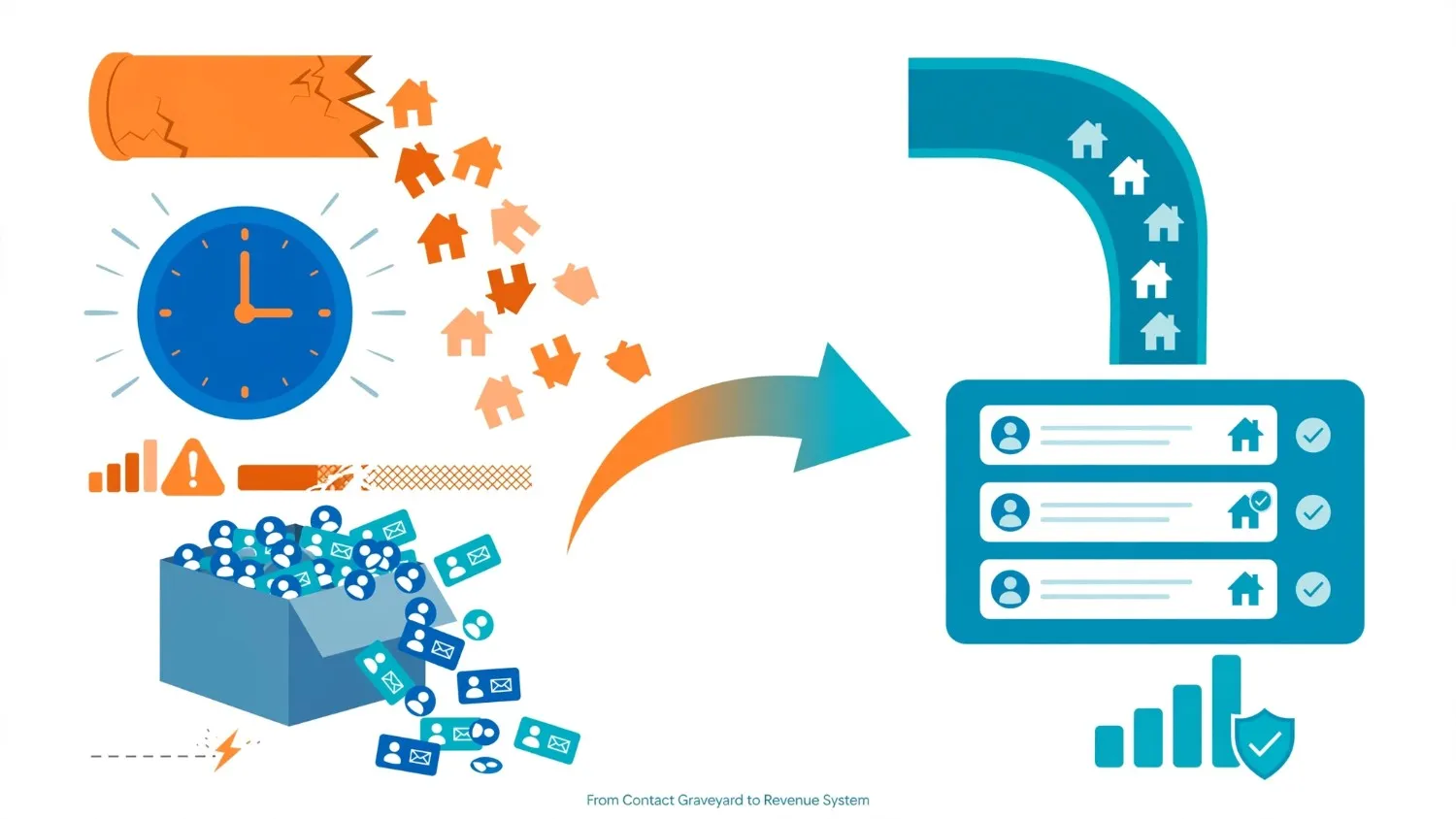
Why Real Estate VA CRM Management Solves the Lead Loss Problem
Before diving into the specific tasks, it helps to understand the scale of the problem a VA-managed CRM actually solves.
Consider what happens to a lead in an unmanaged pipeline:
- A buyer submits an inquiry on your IDX website at 9:00 PM on a Tuesday.
- You see it Wednesday morning at 9:30 AM – over 12 hours later.
- You send a brief email reply between client calls.
- The lead responds Thursday afternoon, but you are in a listing appointment.
- By Friday, the conversation has gone cold.
- The buyer tours a property with a competing agent on Saturday.
This sequence is not exceptional. According to current benchmark data, the average real estate agent takes over 15 hours to respond to an inbound lead inquiry. Within that first hour, the odds of successfully contacting a lead decay by more than 10 times. The commission that belonged to you goes to the agent who responded first.
A real estate VA operating a structured CRM management system short-circuits this pattern entirely. They monitor lead intake continuously, respond or enroll contacts in follow-up sequences within minutes, and maintain the pipeline so that every contact at every stage receives appropriate attention on the appropriate schedule – regardless of what the agent is doing at that moment.
What Real Estate VA CRM Management Actually Includes
Many agents assume CRM management means “updating contact records.” In practice, it is a multi-dimensional workflow that spans five core functional areas.
1. Lead Intake and Immediate Response Protocol
The highest-leverage moment in any lead’s lifecycle is the first five minutes. A trained real estate VA manages this window by establishing and executing a documented lead intake protocol.

When a new lead enters the CRM from any source, the VA:
- Identifies the lead source (Zillow, Realtor.com, IDX website, Facebook lead ad, open house sign-in, referral)
- Creates or merges the contact record with accurate data from the inquiry form
- Assigns the correct pipeline stage: “New Lead,” “Attempting Contact,” “Contacted,” or “Qualified”
- Tags the contact with source, property interest, price range, and timeline indicators
- Enrolls the contact in the appropriate drip sequence immediately
- Either sends an initial response message personally or verifies that the automated response has triggered correctly
- Logs the intake action in the CRM activity feed with a timestamp
For agents using platforms like Follow Up Boss, this intake workflow can run within minutes of lead arrival. The VA monitors new lead notifications throughout their working hours and treats every intake as a time-critical task.
Why this matters: Agents lose deals not because they have bad leads but because those leads receive no meaningful response during the window when they are most engaged. VA-managed intake closes that window permanently.
2. Contact Segmentation and Pipeline Stage Management
A CRM with 3,000 contacts and no meaningful segmentation is not an asset. It is noise. A real estate VA transforms a flat contact list into a structured, segmented pipeline that allows the agent to focus their personal energy on the right people at the right time.
Effective segmentation by a trained REVA includes:
By buyer/seller status:
- Active buyer (searching now, ready to transact)
- Future buyer (6-12 month timeline)
- Long-term nurture (12+ months or undetermined timeline)
- Past client (closed transaction, referral source)
- Active seller lead
- Sphere of influence contact
By behavioral signals:
- Email open frequency (high engagement vs. passive)
- Property search activity on IDX (actively browsing vs. dormant)
- Response to previous outreach (responsive vs. no-reply)
- Website return visits (indicates renewed interest)
By deal stage:
- Pipeline stage progression: New Lead → Attempting Contact → Active Prospect → Under Agreement → Closed
- Each stage has a defined set of tasks, response time expectations, and next actions
The VA reviews and updates these segment assignments regularly, not just when a lead first enters the system. A contact who was a “12-month buyer” three months ago may now be actively searching. Keeping segment assignments current ensures the right sequence and the right contact frequency is always applied.
3. Drip Campaign Enrollment and Sequence Management
Drip campaigns and automated follow-up sequences are only as effective as the human managing them. A sequence that fires generic emails to everyone regardless of behavior, timeline, or source produces unsubscribes, not conversions.
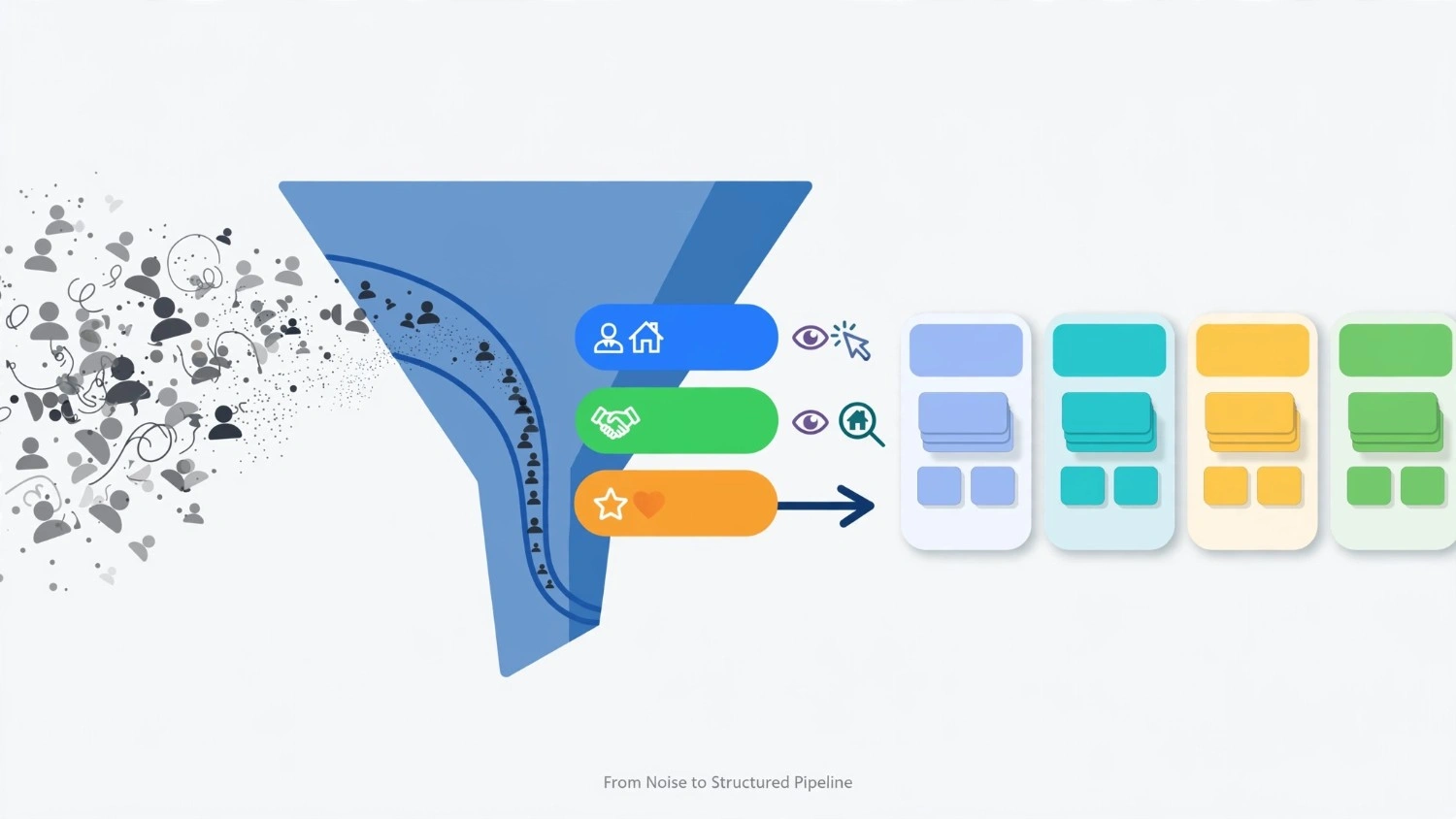
Real estate VA CRM management at the sequence level includes:
Enrollment management:
- Enrolling each contact in the sequence that matches their source, stage, and timeline
- Ensuring no contact is enrolled in multiple conflicting sequences simultaneously
- Removing contacts from sequences when they advance to a stage requiring personal outreach
- Re-enrolling cold contacts in re-engagement sequences when appropriate
Sequence performance monitoring:
- Tracking open rates and click-through rates by sequence
- Identifying sequences with high unsubscribe rates that need content revision
- Flagging contacts who have opened multiple emails but not responded as high-priority warm leads for personal agent outreach
- Monitoring delivery failures and updating contact email addresses when emails bounce
Personalization within automation:
- Reviewing scheduled emails before they send for relevance to the current pipeline stage
- Adding manual touches – a personal text or voicemail note – at key sequence milestones to supplement automation
- Adjusting send frequency for contacts who show high engagement versus low engagement
This level of sequence management converts a generic email machine into a genuine nurture system that moves contacts toward decisions rather than simply checking a follow-up box.
4. Database Hygiene and CRM Accuracy Maintenance
CRM databases naturally degrade over time. Contact details change, records duplicate, stage assignments go stale, and dead leads accumulate alongside active ones. Industry data shows that CRM databases decay at roughly 25-30% per year when not actively maintained. For a 2,000-contact database, that is 500-600 records becoming unreliable annually.
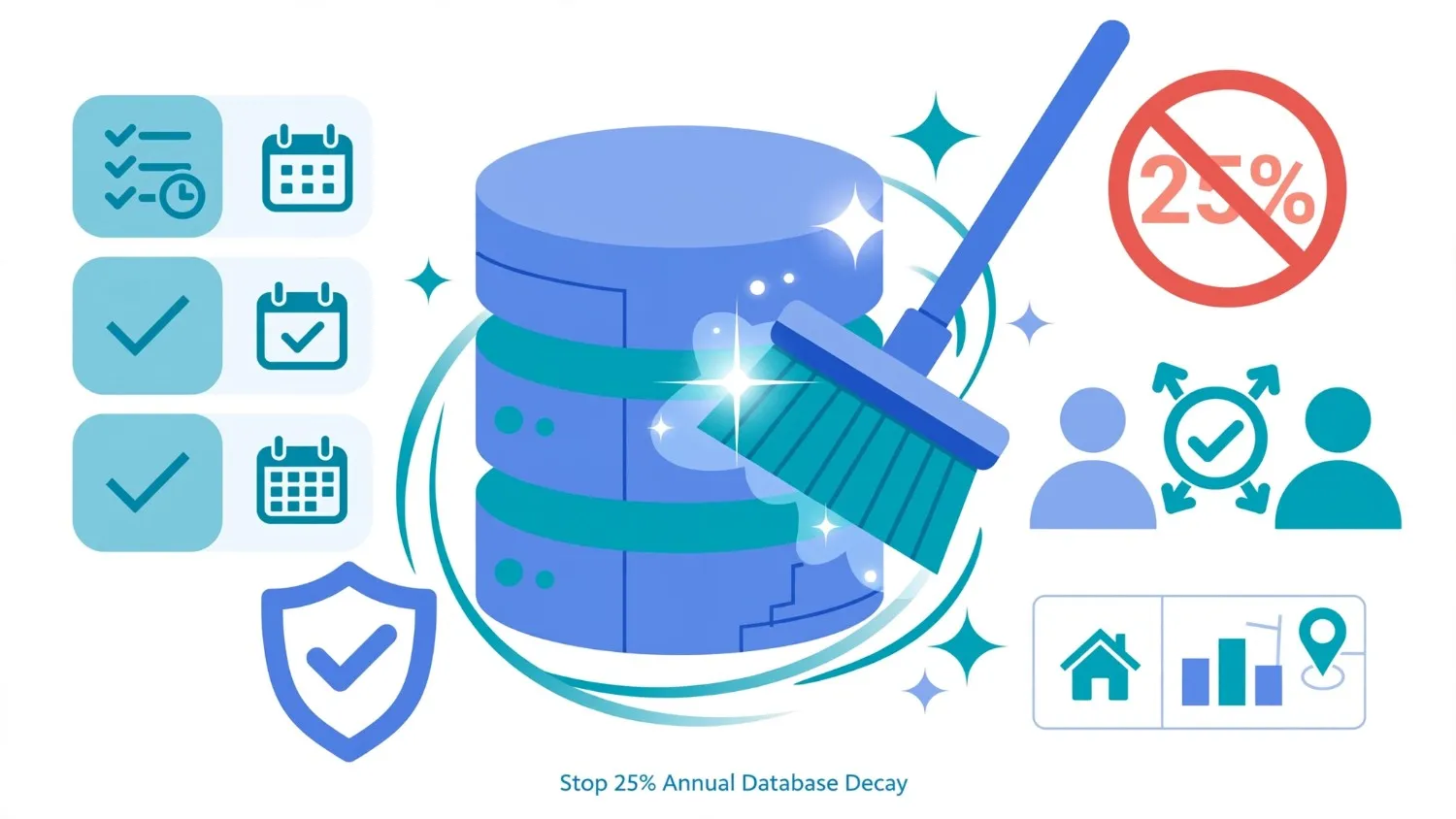
A trained real estate VA maintains database hygiene through recurring structured processes:
Daily hygiene tasks:
- Reviewing and correcting new contact records for data completeness (name, email, phone, source, stage)
- Merging duplicate records created by leads submitting multiple inquiries from different forms
- Logging all communication activity against the correct contact record
- Updating pipeline stages for any contact that has advanced or been disqualified
Weekly hygiene tasks:
- Running a stale pipeline audit: identifying contacts in “Attempting Contact” who have not had a touchpoint in 7+ days
- Reviewing contacts in active sequences who have gone non-responsive for 21+ days
- Verifying that all contacts in the pipeline have a defined “next action” and a scheduled follow-up date
- Checking for contacts whose email has bounced and updating records with corrected contact information
Monthly hygiene tasks:
- Full pipeline review: auditing every active contact against their current assigned stage
- Re-segmenting contacts whose timeline has materially changed
- Archiving or removing genuinely dead leads to keep the active pipeline accurate
- Generating a database health report: total active contacts, segment distribution, email deliverability rate, and sequence enrollment coverage
This structured hygiene practice ensures that the CRM remains a reliable operational tool rather than a historical archive of contacts who may or may not still be relevant.
5. Behavioral Trigger Monitoring and Hot Lead Identification
One of the most powerful functions a real estate VA performs in CRM management is monitoring behavioral signals that indicate a contact is moving toward a transaction decision – and alerting the agent before that window closes.
Modern real estate CRMs and IDX platforms track extensive behavioral data:
- Property search activity: how often, which properties, what price ranges
- Email engagement: opens, link clicks, specific property report requests
- Website revisits: contacts returning to the agent’s site after a period of dormancy
- Valuation tool usage: sellers requesting updated home valuations
- Listing alert engagement: contacts clicking through on specific listing alerts
A trained REVA reviews this behavioral data daily and flags contacts who have triggered high-intent signals for immediate personal agent outreach. Rather than the agent spending an hour reviewing behavioral dashboards, they receive a prioritized list from their VA each morning: “These three contacts showed high-intent behavior in the last 24 hours – here are the specific signals and the suggested outreach approach.”
This hot lead identification function is frequently the highest single-day revenue impact a VA delivers. A seller who has requested three valuations in two weeks and visited the agent’s website four times in the past ten days is not a “maybe someday” contact. They are a listing appointment waiting to be scheduled.
The Daily CRM Management Workflow: A Real VA’s Routine
To make this concrete, here is what a structured real estate VA CRM management day actually looks like.
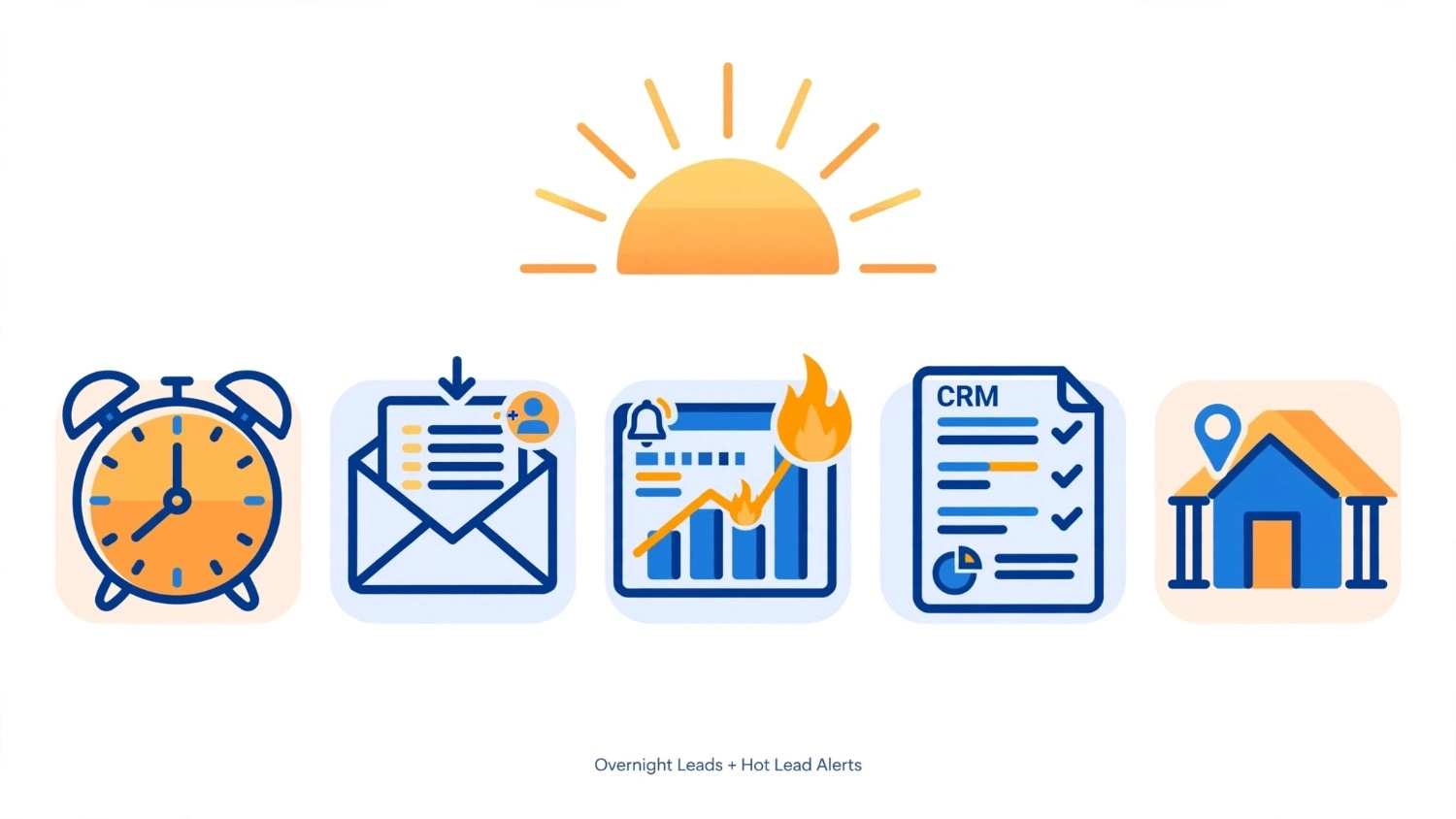
Morning Block (7:00 AM – 9:00 AM)
- Review all new leads that entered the CRM overnight from any source
- Complete intake protocol for each new lead: record creation, tagging, stage assignment, sequence enrollment
- Check automated response delivery confirmations: verify all triggered emails sent correctly
- Review behavioral activity dashboard: flag high-engagement contacts for agent hot list
- Send morning CRM summary to agent: new leads, hot lead alerts, pipeline stage movements overnight
Mid-Morning Block (9:00 AM – 11:00 AM)
- Execute manual follow-up touches for contacts in “Attempting Contact” stage who have not responded to automation
- Update pipeline stages for any contacts the agent advanced during morning appointments
- Process any incoming replies to drip campaigns: route responses to agent, log in CRM, adjust sequence status
- Check email deliverability: flag bounced addresses, update contact records
Afternoon Block (1:00 PM – 3:00 PM)
- Run stale contact audit: identify any active pipeline contacts with no touchpoint in 7+ days
- Review upcoming drip sequence sends: verify content relevance for scheduled contacts
- Process open house sign-in sheets or event contacts (if applicable): enter, tag, enroll
- Database spot-check: verify 20-30 random contact records for accuracy and completeness

End-of-Day Block (4:00 PM – 5:00 PM)
- Compile daily pipeline activity summary for agent review: contacts advanced, contacts engaged, contacts requiring personal attention
- Schedule next actions for high-priority contacts in the task queue
- Flag any CRM anomalies: duplicate records identified, sequence enrollment errors, delivery failures
- Prepare morning hot lead list for the following day based on day’s behavioral activity

CRM Platform Proficiency: What a Trained REVA Knows
Effective real estate VA CRM management requires platform-specific knowledge, not just general organizational skills. A qualified REVA brings operational fluency in the platforms most commonly used by real estate professionals.
Follow Up Boss
Follow Up Boss functions as a centralized command hub for lead management, integrating with virtually every lead source agents use. A trained VA operating in Follow Up Boss manages:
- Smart Lists: saved filtered contact views organized by stage, source, last activity date, and behavioral flags
- Action Plans: automated multi-step follow-up sequences combining email, SMS, and task reminders
- Lead routing: ensuring incoming leads from integrated sources (Zillow, BoomTown, IDX providers) route correctly to the right pipeline stage
- Team inbox management: processing shared inbox messages, routing to the appropriate agent where applicable
- Reporting: generating lead source performance reports, response time tracking, and pipeline conversion metrics
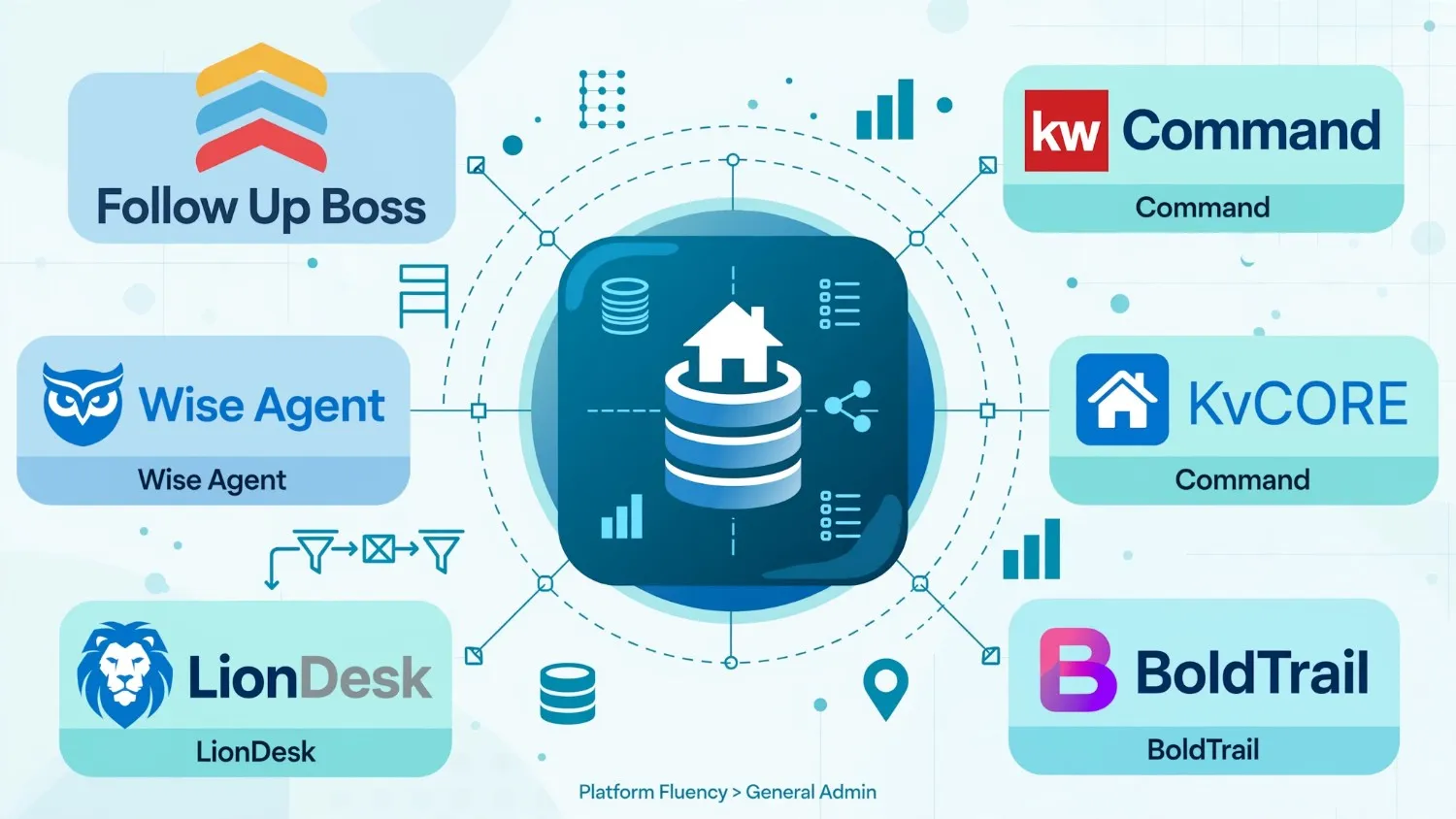
KvCORE (BoldTrail)
KvCORE is an all-in-one platform combining IDX website, CRM, and marketing automation. VA management within KvCORE includes:
- Behavioral automation: ensuring AI-driven behavioral follow-up triggers are configured correctly and firing as intended
- Smart CRM: reviewing and maintaining the behavioral score system that ranks lead engagement
- Lead pond management: monitoring unassigned lead pools for teams and ensuring timely agent assignment
- IDX property search activity: monitoring which contacts are actively searching and what properties they are saving or viewing
Other Common Platforms
A skilled REVA also works effectively within LionDesk, Wise Agent, Sierra Interactive, Lofty (formerly Chime), HubSpot, and brokerage-specific CRMs. The underlying workflow principles transfer across platforms even when interface details differ.
Key Performance Indicators for VA-Managed CRM Operations
Without measurable benchmarks, agents cannot evaluate whether their real estate VA CRM management is producing the performance gains it should. These KPIs provide an objective framework.
| KPI | Definition | Target Benchmark |
|---|---|---|
| Lead Response Time | Time from lead entry to first contact attempt | Under 5 minutes for inbound digital leads |
| Sequence Enrollment Rate | Percentage of new leads enrolled in appropriate drip sequence | 100% within 2 hours of intake |
| CRM Data Completeness | Percentage of active contacts with all required fields populated | 95%+ |
| Pipeline Stage Accuracy | Percentage of contacts assigned to the correct current stage | 95%+ |
| Active Pipeline Coverage | Percentage of pipeline contacts with a scheduled next action | 100% |
| Email Deliverability Rate | Percentage of outbound emails successfully delivered | 98%+ |
| Stale Contact Rate | Percentage of active leads with no touchpoint in 14+ days | Below 5% |
| Hot Lead Alert Turnaround | Time from behavioral trigger to agent notification | Same business day |
Reviewing these KPIs monthly gives agents a clear view of whether their CRM is functioning as a revenue system or degrading toward a historical archive.
Common CRM Management Mistakes Agents Make Without VA Support
Even agents who intend to manage their CRM actively fall into predictable patterns that undermine pipeline performance.
Mistake 1: Treating the CRM as an Inbox, Not a System
Many agents use their CRM reactively: they check it when something prompts them to. A CRM functions as a revenue system only when it is managed proactively – which means scheduled maintenance, daily reviews, and active stage management rather than occasional use as a contact lookup tool.
Mistake 2: Leaving Stage Assignments Stagnant
A contact tagged as “New Lead” three months after entering the pipeline is a data accuracy failure. Stale stage assignments make pipeline reporting meaningless and prevent the agent from accurately assessing their actual active opportunity pool.
Mistake 3: Setting and Forgetting Drip Sequences
Automation does not manage itself. A drip sequence that fires the same eight emails to every contact regardless of behavior, engagement, or timeline change is generating unsubscribes and training contacts to ignore your communications. Human oversight of automated sequences – provided by a trained REVA – is what converts automation from noise into nurture.
Mistake 4: Ignoring Database Hygiene Until It Becomes a Crisis
Most agents address database hygiene once the problem becomes severe: duplicate records causing embarrassing double-outreach, bounced emails indicating an outdated list, or sequences firing to past clients who have already referred multiple people. Regular proactive maintenance by a VA prevents these crises.
Mistake 5: Not Reviewing Behavioral Data
IDX behavioral data and email engagement metrics are consistently the most underutilized intelligence available to real estate agents. Contacts who are actively searching, revisiting your website, or engaging heavily with your emails are broadcasting intent signals. Without a VA reviewing this data daily, those signals go unread and those opportunities go to competing agents.
Expert Tips for Getting Maximum Value from VA CRM Management
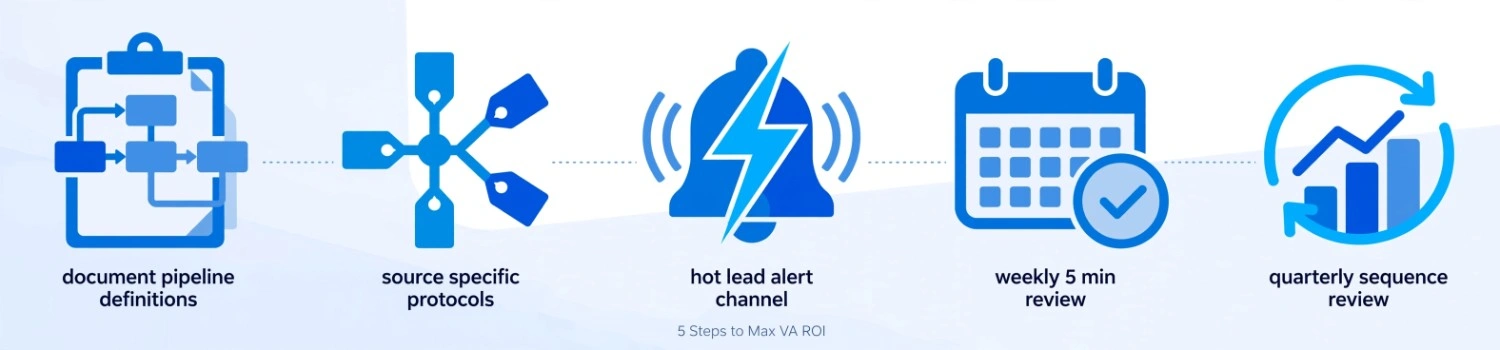
Tip 1: Document your pipeline stage definitions before delegating.
Your VA cannot maintain accurate stage assignments if you have not defined what each stage means in your specific business. Write a one-page document: what constitutes a “New Lead,” what constitutes an “Active Prospect,” what actions are required before a contact advances from “Contacted” to “Qualified.” This clarity enables independent, accurate stage management from day one.
Tip 2: Create source-specific intake protocols.
A Zillow buyer lead requires different immediate response and sequence enrollment than a seller who requested a CMA from your website. Build a source-specific intake guide that your VA can reference for every lead type you receive, ensuring the right sequence reaches the right person every time.
Tip 3: Build a “hot lead alert” communication channel.
Set up a dedicated Slack channel or text thread where your VA sends same-day alerts for contacts who trigger high-intent behavioral signals. Structure the alert format: contact name, behavioral trigger observed, suggested response, and contact information. This gives you actionable intelligence in seconds rather than requiring you to review the CRM dashboard yourself.
Tip 4: Schedule a weekly five-minute pipeline review.
Even with a VA managing your CRM daily, a weekly five-minute scan of the pipeline summary report keeps you aligned with what is happening in your database. Your VA can prepare this as a brief written summary each Monday morning: total active pipeline, new leads this week, hot leads requiring personal attention, and any database health flags.
Tip 5: Review sequence performance quarterly.
Your VA monitors individual contact sequences daily, but a quarterly review of overall sequence performance – open rates, click rates, unsubscribe rates, and conversion rates by sequence – gives both you and your VA the data needed to improve content and adjust send frequency strategically.
FAQs: Real Estate VA CRM Management
What does real estate VA CRM management include on a daily basis?
Daily real estate VA CRM management includes lead intake and record creation for all new contacts, pipeline stage updates for contacts that advanced or went inactive, sequence enrollment verification for new leads, behavioral activity monitoring to flag high-intent contacts, email deliverability checks, stale contact identification, and a daily pipeline summary report for the agent. The exact task mix depends on the CRM platform, lead volume, and agreed scope, but these core activities represent the standard daily workflow for a trained REVA.
How does a real estate VA prevent leads from falling through the cracks?
A VA prevents lead loss through three primary mechanisms: immediate intake protocol (every new lead is recorded, tagged, and enrolled in a follow-up sequence within minutes of arrival), continuous pipeline monitoring (no contact advances to a stale status without triggering a follow-up action), and behavioral trigger alerts (high-intent contacts are flagged to the agent the same day the signal appears). Together, these practices close the gaps where leads most commonly disappear: slow initial response, lapsed follow-up, and unmonitored behavioral signals.
Which CRM platforms does a real estate VA work with most effectively?
Trained real estate VAs most commonly work with Follow Up Boss, KvCORE (BoldTrail), LionDesk, Wise Agent, Sierra Interactive, and Lofty. Many also work within brokerage-specific platforms like Compass CRM or Keller Williams Command. The underlying CRM management principles – segmentation, stage management, hygiene, and behavioral monitoring – transfer across platforms, though platform-specific training accelerates productivity for any given tool.
How does real estate VA CRM management improve lead conversion rates?
The primary conversion improvement comes from response velocity and follow-up consistency. Agents using actively managed CRMs see lead-to-appointment conversion rates climb 30-35% compared to self-managed or neglected pipelines, according to current industry benchmark data. The mechanism is straightforward: leads who receive immediate, consistent, personalized follow-up at the right stage and the right frequency convert at higher rates than leads who receive sporadic outreach whenever the agent has capacity.
How long does it take for a VA to take over CRM management effectively?
A trained REVA with real estate platform experience typically reaches independent, productive CRM management within 1-2 weeks. The critical variable is how well the agent documents their pipeline stage definitions, segmentation conventions, and source-specific intake protocols before handoff. Agents who provide a clear written guide for their CRM conventions and record a few Loom walkthrough videos of their existing workflow see their VA reach full operational competency significantly faster than those who hand over access without documentation.
Can a real estate VA manage CRM for multiple agents or teams?
Yes, within defined scope limits. Some REVAs specialize in team-level CRM management, handling pipeline oversight for multiple agents under a shared platform like Follow Up Boss for Teams or KvCORE team accounts. This typically requires a clearly defined scope – which agent’s pipeline the VA owns exclusively versus which tasks are shared – along with clear communication protocols for flagging urgent items to the right agent in real time.
Your CRM Is Only as Good as the Person Managing It
The technology is not the problem. Every major real estate CRM platform available today is capable of powering a genuine lead conversion machine. The gap between what these platforms can do and what most agents experience from them is not a feature gap. It is a management gap.

Real estate VA CRM management closes that gap by placing a trained, dedicated operator behind the system – someone whose primary responsibility is keeping every contact tracked, every sequence running, every behavioral signal reviewed, and every pipeline stage accurate. The result is a CRM that functions as the revenue infrastructure it was built to be: proactive, current, and converting.
Leads stop falling through cracks not because the system got smarter, but because a human being is now responsible for making sure every crack is covered.
When you are ready to transform your pipeline from a passive database into an actively managed conversion system, that keeps your pipeline clean, your follow-up consistent, and your lead loss rate at zero.
Work with RLIVO to build a CRM-focused Real Estate VA Operation →
Pingback: AI-Trained Real Estate Virtual Assistant vs Offshore VA
Pingback: Real Estate Virtual Assistant Tools: The Core Tech Stack