
Real estate virtual assistant cost ranges from $7 per hour for offshore direct-hire candidates to $75+ per hour for U.S.-based boutique agency placements, with full-time managed engagements typically running $1,500 to $3,500 per month depending on specialization level, geographic talent source, and whether the arrangement is direct-hire or agency-managed. The total cost of ownership, however, extends beyond the quoted rate to include management overhead, onboarding investment, software access, and the opportunity cost of agent time spent supervising instead of producing. Agents who evaluate real estate VA pricing on hourly rate alone consistently either overpay by choosing the wrong service tier or underpay and inherit a performance and reliability problem they did not budget for.
Understanding exactly what drives these price differences – and what you actually receive at each price point – is the only reliable basis for a cost decision that produces positive ROI.
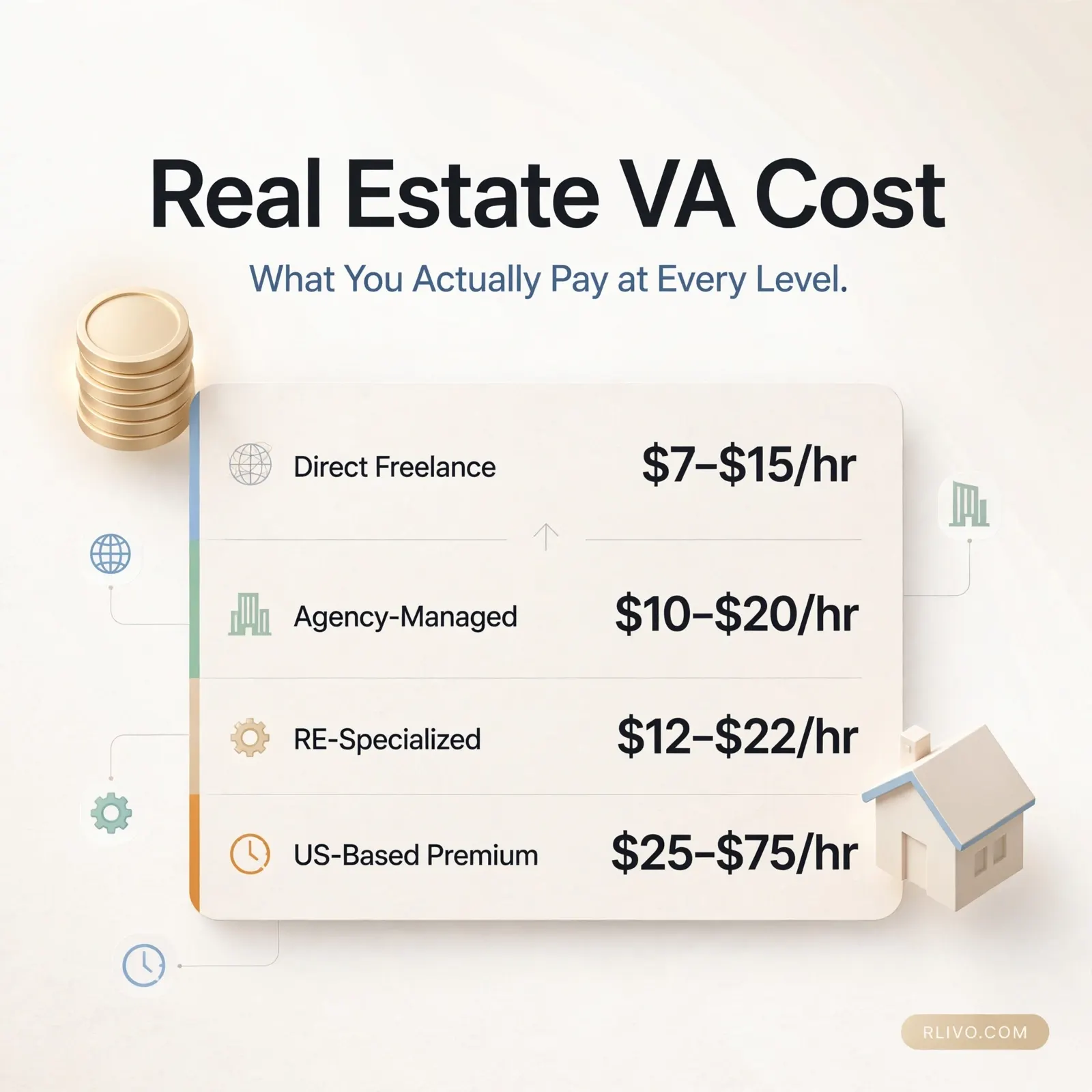
This guide breaks down every service level, every pricing model, and every hidden cost variable so you can evaluate real estate virtual assistant cost accurately, not just cheaply.
If your priority is to skip the research phase and work directly with a team that has already built the pricing structure, vetting standards, and onboarding infrastructure around real estate operations, explore purpose-built real estate virtual assistant services designed specifically for agents and brokerages.
What Determines Real Estate Virtual Assistant Cost?
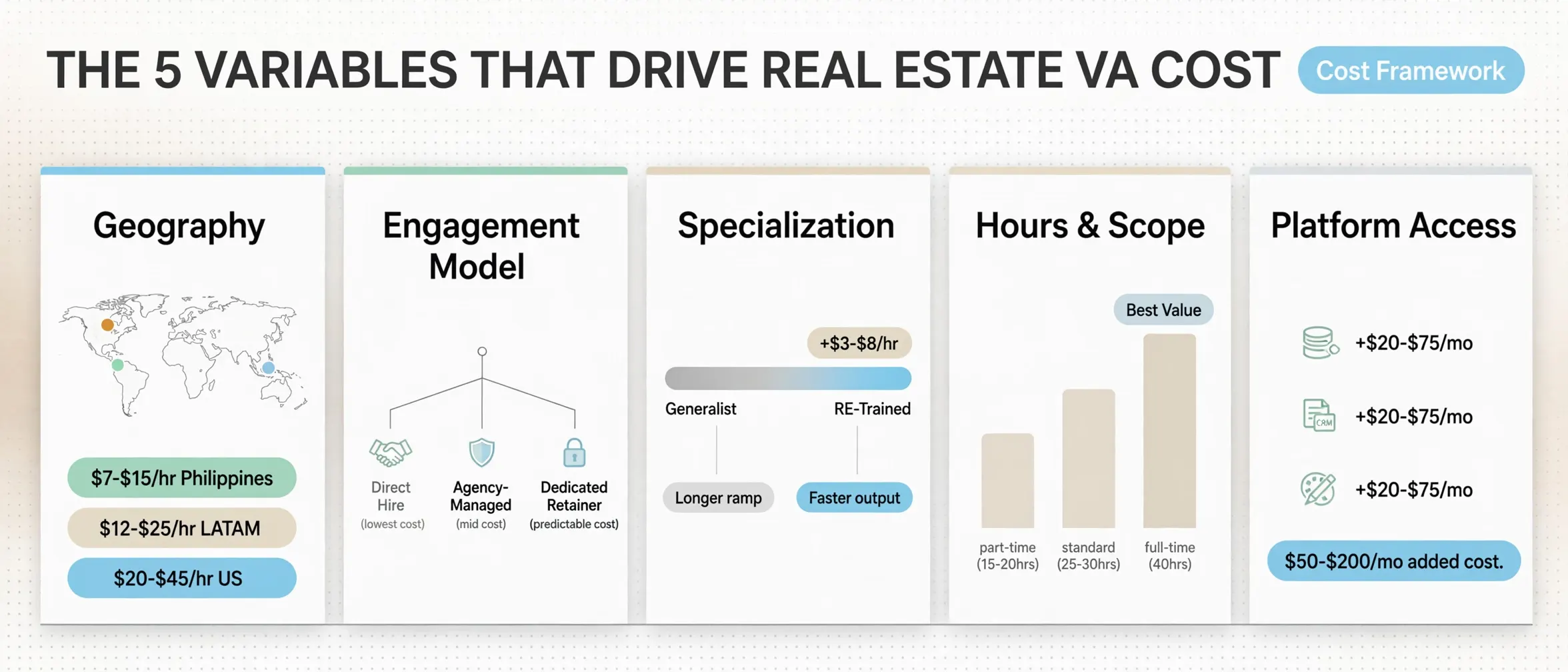
Before comparing numbers, it helps to understand the variables that drive price differences across the market. Real estate VA cost is not a single number – it is the product of at least five intersecting factors.
1. Geographic Talent Source
Location is the single largest cost variable. The same functional skill set commands dramatically different rates depending on where the VA is based:
- United States: $20-$45 per hour for general real estate admin support; $40-$75+ for specialized roles or agency placements
- Latin America (Colombia, Mexico, Argentina): $12-$25 per hour; strong time-zone alignment with U.S. markets
- Philippines: $7-$15 per hour; largest offshore talent pool with high real estate industry familiarity
- India and South Asia: $5-$12 per hour; strong generalist admin and data management capabilities
According to ZipRecruiter’s current salary data, U.S.-based real estate assistants average approximately $24 per hour, which represents the domestic baseline before any agency markup or benefits overhead.
2. Engagement Model
How you structure the working relationship affects your cost more than geography alone:
- Direct freelance hire: You source, vet, contract, and manage the VA yourself. Lowest quoted rate; highest management overhead.
- Agency-managed placement: The agency sources, screens, contracts, and provides management support. Higher rate; lower management burden.
- Dedicated full-time retainer: A flat monthly fee for exclusive, full-time VA support. Predictable cost; best value per hour at scale.
- Shared or pool-based VA: Multiple clients share one VA’s time. Lowest cost; least reliable availability and response consistency.
3. Specialization Level
A generalist VA who learns real estate on the job costs less upfront but requires more training investment. A REVA with pre-existing expertise in Follow Up Boss, Dotloop, and MLS systems commands a premium – and delivers productive output significantly faster. Specialization premium typically adds $3-$8 per hour to the base rate but reduces onboarding time from weeks to days.
4. Hours and Scope
Part-time arrangements (15-20 hours per week) offer flexibility but often carry a higher effective hourly rate than full-time engagements. Agencies and managed services typically offer volume discounts at 30-40 hours per week that can reduce the effective per-hour cost by 15-25%.
5. Platform and Tool Access
Many agents forget that adding a VA to their CRM, MLS platform, or transaction management system carries its own cost. User seats for platforms like Follow Up Boss or Dotloop add $20-$75 per month per additional user depending on the plan. That incremental software cost belongs in your total VA budget calculation.
Real Estate Virtual Assistant Cost by Service Tier
The market organizes into four distinct service tiers, each with a different cost structure, risk profile, and value proposition.
Tier 1: Direct Freelance Hire (Lowest Cost, Highest Management Requirement)
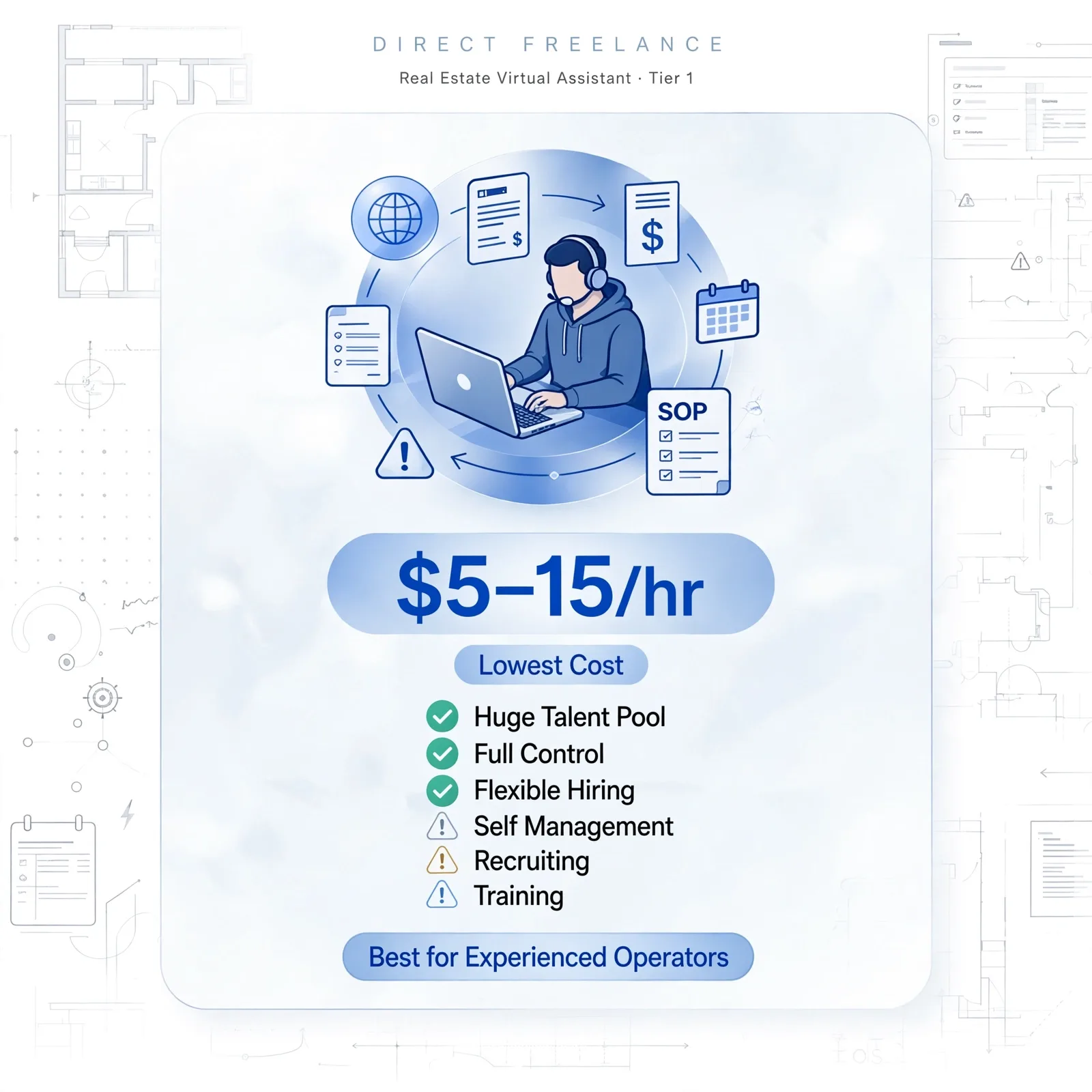
Cost range: $5-$15 per hour (offshore); $18-$35 per hour (U.S.-based) Monthly equivalent (full-time): $800-$2,400 (offshore); $2,880-$5,600 (U.S.-based) Best platforms: OnlineJobs.ph, VirtualStaff.ph, Upwork
At this tier, you take full ownership of every aspect of the hiring relationship. You source the candidate, conduct all screening, negotiate the rate, manage the contract, run payroll, and handle all ongoing performance management.
What you get:
- Access to a very large candidate pool
- Maximum flexibility in candidate selection and compensation negotiation
- No agency markup or management fee
- Direct relationship with the VA from day one
What you are responsible for:
- 10-20 hours of sourcing and screening time per hire cycle
- All onboarding documentation and training materials
- Management overhead on an ongoing basis
- Replacement recruiting if the VA churns
Real cost consideration
Stealth Agents’ virtual assistant pricing research identifies hidden costs for freelance hires – including recruiting time, retraining after turnover, and management overhead – that typically add $2,000-$6,000 per year to the quoted rate. For agents who account for their own time at $100-$200 per hour, the management overhead alone can negate the direct-hire cost savings within the first six months.
This tier works best for: experienced operators who have hired VAs before, have documented SOPs ready, and can manage a remote worker efficiently without significant supervision overhead.
Tier 2: Agency-Managed Placement (Mid-Range Cost, Reduced Risk)
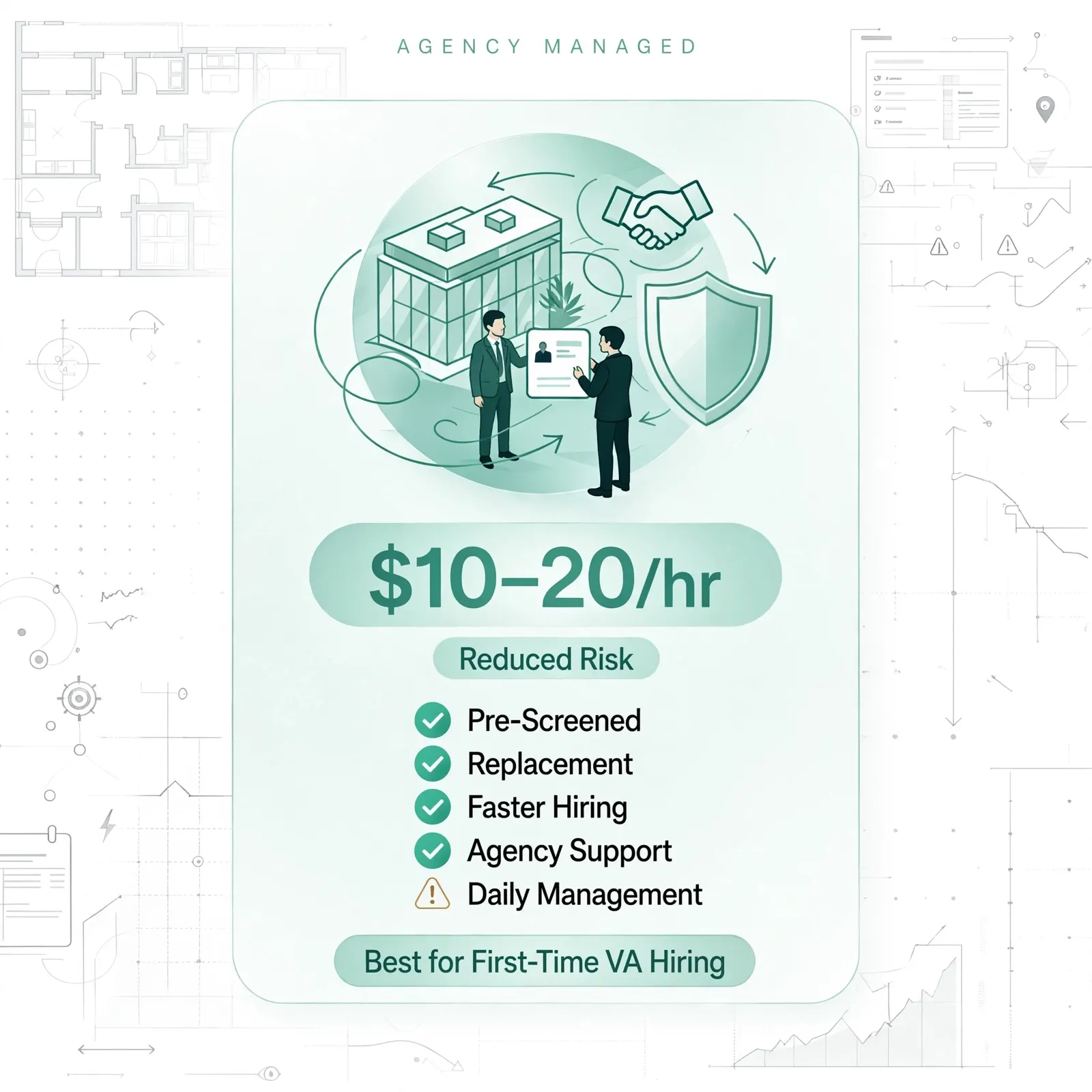
Cost range: $10-$20 per hour (offshore-placed agency)
Monthly equivalent (full-time): $1,600-$3,200 per month
Representative providers: Stealth Agents, ClearDesk, Pavago, similar managed VA services
At this tier, the agency handles candidate sourcing, initial vetting, skills assessment, and placement. Most providers at this level also offer replacement guarantees, which means if the initial placement does not perform, the agency replaces the VA without an additional placement fee.
What you get:
- Pre-screened candidate delivered to you, ready to onboard
- Replacement guarantee (typically 30-90 day window)
- Agency as an intermediary for administrative and compliance issues
- Faster time-to-productivity than direct hire
What you are still responsible for:
- All onboarding documentation and task-specific training
- Day-to-day performance management and feedback
- Building the workflows and SOPs the VA will follow
Real cost consideration
The 20-40% agency markup over direct-hire rates reflects the cost of the vetting infrastructure, replacement guarantee, and placement support. For first-time VA hirers or agents without an established screening process, this markup frequently pays for itself in avoided bad hires. According to research on hiring cost structures, a fully loaded U.S. full-time administrative hire costs $55,000-$85,000 per year. An equivalent offshore managed VA costs $19,200-$38,400 annually, representing savings of $16,000-$65,000 per year before accounting for benefits, office overhead, and payroll tax.
This tier works best for: growing solo agents and small teams hiring their first or second VA who want reduced placement risk without the premium pricing of specialized real estate VA agencies.


Tier 3: Real Estate-Specialized Agency (Premium Cost, Maximum Domain Expertise)
Cost range: $1,988-$3,500+ per month (dedicated full-time)
Representative providers: MyOutDesk, Summit VA Solutions, similar RE-specific agencies
Engagement model: Flat monthly retainer for dedicated, full-time support
Real estate-specialized agencies pre-train their VAs in industry-specific workflows, platforms, and terminology before placement. The VA they deliver understands MLS conventions, escrow timelines, and real estate CRM systems from the first day of the engagement.
MyOutDesk, one of the most recognized providers in this category, prices its standard full-time placement at approximately $1,988 per month on a month-to-month basis, with lower rates available on 6-month and 12-month commitments.
What you get:
- Domain-trained VA who understands real estate operations from day one
- Significantly compressed onboarding timeline (days rather than weeks)
- Pre-built familiarity with CRM platforms, transaction workflows, and listing protocols
- Replacement guarantee and ongoing agency support
- Established track record and provider accountability
What you are still responsible for:
- Business-specific SOPs and workflow documentation
- Platform access and tool provisioning
- Performance management and feedback
Real cost consideration
The premium over Tier 2 is substantial – typically $600-$1,500 per month more. The justification is productivity velocity: a Tier 3 VA typically reaches full operational output in 1-2 weeks rather than 3-5 weeks. For an agent closing 15+ transactions per year, two to four weeks of faster onboarding productivity represents a meaningful ROI difference. For agents closing fewer transactions, the premium may not justify the cost differential.
This tier works best for: established agents and teams with high transaction volume who need a VA that contributes immediately and cannot absorb a multi-week onboarding ramp.
Tier 4: U.S.-Based Premium VA (Highest Cost, Domestic Alignment)
Cost range: $25-$55 per hour; $30-$75+ for boutique agency placements
Monthly equivalent (full-time): $4,000-$8,800+
Engagement model: Direct hire, premium agency, or specialized boutique firm
At this tier, the VA is U.S.-based – typically working in the same time zone, often with direct real estate industry experience as a former transaction coordinator, listing manager, or brokerage administrator.
What you get:
- Full domestic time-zone alignment and same-day real-time availability
- U.S. legal and regulatory familiarity
- Highest baseline written communication quality for client-facing work
- No cultural or communication nuance gaps
Real cost consideration
The Bureau of Labor Statistics reports a median annual wage of $47,460 for secretaries and administrative assistants. When employer benefit costs (averaging $15.33 per hour per BLS December 2025 data) are added to the wage cost, a full-time U.S.-based employee in this category carries a total employer cost of $60,000-$90,000+ per year. The U.S.-based VA model eliminates benefits, payroll tax, and overhead costs but retains the underlying labor rate – making it significantly less cost-efficient than offshore options unless the domestic alignment provides specific operational value that offshore cannot replicate.
This tier works best for: luxury market agents, large brokerages requiring highly client-facing VA support, or operations where same-timezone real-time communication is genuinely non-negotiable.
Real Estate VA Cost: Full Comparison Table
| Service Tier | Hourly Rate | Monthly Cost (Full-Time) | Vetting Responsibility | Onboarding Speed | Best For |
|---|---|---|---|---|---|
| Direct Freelance (Offshore) | $5-$15/hr | $800-$2,400 | Buyer manages all | 3-6 weeks | Experienced operators with SOPs |
| Direct Freelance (U.S.) | $18-$35/hr | $2,880-$5,600 | Buyer manages all | 2-4 weeks | U.S. time-zone dependent roles |
| Agency-Managed (Offshore) | $10-$20/hr | $1,600-$3,200 | Agency pre-vets | 2-4 weeks | First-time VA hirers, growing teams |
| RE-Specialized Agency | $12-$22/hr | $1,988-$3,500 | Agency pre-vets + trains | 1-2 weeks | High-volume agents, established teams |
| U.S.-Based Premium | $25-$75/hr | $4,000-$12,000+ | Variable | 1-3 weeks | Luxury market, client-facing roles |
The True Cost of a Real Estate VA: Beyond the Hourly Rate
Hourly rate is the most visible cost number. It is also the least complete one. A thorough evaluation of real estate virtual assistant cost requires accounting for several cost categories that rarely appear in the quoted rate.
LAYERS MOST AGENTS MISS
stop calculating.
Onboarding and Training Investment
Every VA hire requires onboarding investment, whether the agent pays in cash or in time. The relevant costs include:
- Agent time spent recording SOPs and Loom videos: At $100-$200 per agent hour, a 10-hour onboarding preparation investment costs $1,000-$2,000 in opportunity cost
- Reduced output during the ramp period: A VA operating at 60% efficiency for three weeks produces roughly $300-$600 of lost output value at a $10/hr rate
- Error correction time: Early-stage mistakes in CRM entries, email communications, or listing data require agent review time that has its own cost
These costs are real regardless of which tier you choose. They are lower at Tier 3 due to pre-existing domain knowledge, but they are never zero.
Management Overhead
A VA who requires 30 minutes of daily supervision and feedback consumes roughly 2.5 hours of agent time per week. At $150 per hour in agent opportunity cost, that is $375 per week – $1,500 per month – in management overhead layered on top of the VA’s quoted rate.
Well-structured onboarding and documented SOPs reduce management overhead to 30-60 minutes per week after the first 30 days. Poorly structured engagements can maintain high oversight requirements for months.
Platform and Tool Access
Adding a VA user to your existing platforms carries incremental subscription costs that belong in the budget:
- CRM user seats: Follow Up Boss adds $25-$75/month per additional user depending on plan tier
- Transaction management: Dotloop and Skyslope charge per-user or per-transaction fees that increase with VA activity
- Communication tools: Slack, Zoom, and project management platforms may require additional seat licenses
- Design tools: Canva Pro, Adobe Express, or similar tools for marketing production
These platform costs typically add $50-$200 per month to the effective VA engagement cost.
Turnover and Replacement Cost
Freelance direct hires carry higher turnover risk than agency-managed placements. When a VA churns, the replacement cycle costs 10-20 hours of recruiting and screening time, a 2-6 week ramp period with a new VA, and the opportunity cost of operational disruption during the transition.
For direct hires, factoring one replacement cycle per year into the cost model is conservative but realistic. At $150 per agent-hour, a 15-hour replacement recruiting cycle costs $2,250 in opportunity cost – equivalent to three to six months of agency markup savings.
Cost vs. Value: The ROI Calculation Most Agents Ignore
Cost analysis without value analysis is incomplete. The relevant question is not “how much does a real estate VA cost?” but “what does a real estate VA generate relative to its cost?”
The Core Value Equation
Consider an agent billing their time at $150 per hour who currently spends 15 hours per week on administrative tasks: CRM updates, email management, listing coordination, social media, and transaction follow-up.
That 15-hour weekly administrative burden costs the agent:
- Weekly opportunity cost: 15 hours × $150 = $2,250
- Monthly opportunity cost: $9,000
- Annual opportunity cost: $108,000
Replacing that 15-hour burden with a $12/hour VA costs:
- Weekly VA cost: 15 hours × $12 = $180
- Monthly VA cost: $720
- Annual VA cost: $8,640
The annual net value creation is the opportunity cost recovered minus the VA cost: $108,000 – $8,640 = $99,360 in recoverable agent capacity per year.
Even with a conservative assumption that the agent only converts 20% of that recovered time into billable activity, the net ROI remains strongly positive. According to research on virtual assistant ROI, companies using VA support consistently see meaningful returns against the investment – with labor cost savings compared to in-house hiring consistently measured at 40-70% across independent studies.
Real Transaction Impact
Beyond the hourly math, a REVA delivers transaction-level value through:
- Faster lead response: Consistent sub-5-minute lead response to inbound digital leads increases conversion rates materially compared to sporadic agent-managed follow-up
- Zero missed contingency deadlines: A VA actively tracking transaction timelines eliminates the deal-killing and liability-generating cost of a missed inspection or financing deadline
- Consistent database maintenance: A clean, well-maintained CRM produces more referrals, better drip campaign performance, and stronger repeat client engagement – all of which compound over time
Common Mistakes Agents Make When Evaluating VA Cost
Mistake 1: Optimizing for the Lowest Hourly Rate
The cheapest hourly rate almost never produces the lowest total cost. Low-rate direct hires from freelance platforms require higher screening investment, longer onboarding, more management overhead, and carry higher turnover risk. Each of those factors adds real cost that does not appear in the hourly rate.
Mistake 2: Ignoring the Cost of Your Own Onboarding Time
Agents frequently calculate VA cost as purely the VA’s rate. They omit the 10-20 hours of their own time required to document processes, record training materials, and run the onboarding period. At $100-$200 per agent-hour, that omission can represent $1,000-$4,000 of unaccounted cost in the first hire cycle.
Mistake 3: Choosing a Shared VA to Save Money
Pool-based or shared VA arrangements assign one VA to multiple clients simultaneously. The cost savings are real – typically 30-50% below dedicated rates. However, shared VAs cannot provide the consistent availability, institutional knowledge of your specific systems, and proactive workflow management that a dedicated VA delivers. For real estate operations where response time and CRM accuracy are primary value drivers, a shared VA model frequently underdelivers in ways that cost more than the savings.
Mistake 4: Not Budgeting for Platform Costs
Agents who calculate VA cost without accounting for the incremental software seats they will need consistently find their first invoice 10-15% higher than their initial budget. Build platform costs into your comparison from the start.
Mistake 5: Evaluating Cost Without a Performance Benchmark
Without defined KPIs, agents cannot determine whether their VA cost is producing value or merely consuming budget. Lead response time, CRM accuracy rate, task completion rate, and agent hours reclaimed are all measurable. Agents who do not track these metrics cannot distinguish a high-performing VA engagement from a mediocre one – and cannot make an informed cost optimization decision.
Expert Tips for Managing Real Estate VA Cost Effectively
Start at the scope you can fully support, not the scope you aspire to
A 20-hour per week engagement with excellent documentation and a clear onboarding plan will outperform a 40-hour engagement launched without preparation. Scale hours after the working rhythm is established.
Calculate your effective hourly cost, not the quoted rate
Divide the total monthly cost – VA rate plus platform fees plus your management time – by the actual productive output hours. This gives you the true cost per productive hour, which is the number that matters for ROI.
Use a trial arrangement before committing to full-time
Most agency-managed providers and direct-hire platforms support a 2-4 week paid trial at reduced scope. A trial costs slightly more per hour but eliminates the risk of a full-time commitment to a poor fit.
Build SOPs before you hire, not after
The onboarding investment is unavoidable. Making it before you hire means your VA’s first productive hours are actually productive rather than spent in a training loop. The upfront documentation cost pays back immediately.
Re-evaluate the engagement quarterly
VA cost-value ratios shift as the engagement matures. A VA who was operating at 70% capacity in month one may be at 95% in month four. Quarterly reviews identify whether to expand scope, adjust hours, or make role changes before cost drift occurs.
FAQs: Real Estate Virtual Assistant Cost
What is the average real estate virtual assistant cost per month?
The average monthly cost depends heavily on service tier and geography. Offshore direct-hire engagements run $800-$2,400 per month for full-time support. Agency-managed offshore placements range from $1,600-$3,500 per month. U.S.-based VA arrangements typically start at $4,000 per month for full-time support. Part-time arrangements scale proportionally, with 20-hour-per-week arrangements costing roughly half the full-time equivalent.
Why does real estate VA cost vary so much across providers?
The variation reflects differences in geographic labor costs, agency overhead and vetting infrastructure, specialization level, and engagement model. A $7/hour direct-hire offshore candidate has no agency markup, no replacement guarantee, and requires the buyer to manage all screening and onboarding. A $22/hour agency-placed real estate-trained VA carries a markup that funds vetting, domain training, and ongoing support infrastructure. Both prices are rational – they reflect different total packages, not just different rates.
Is a cheaper real estate VA always less effective?
Not necessarily. A $10/hour VA with five years of real estate admin experience can outperform a $25/hour VA with generic admin experience in a real estate context. Rate correlates loosely with quality at the extremes but is not a reliable quality proxy in the mid-range. Skills assessment, real estate domain knowledge, and platform proficiency are stronger quality predictors than the hourly rate alone.
What is the real estate virtual assistant cost compared to hiring an in-office employee?
The Bureau of Labor Statistics reports a median annual wage of $47,460 for administrative assistants. When employer benefit costs are added (averaging $15.33 per hour per BLS data), a full-time in-office admin hire carries a total employer cost of $65,000-$90,000+ per year depending on location and benefits package. A full-time offshore agency-managed real estate VA at $1,988-$3,200 per month costs $23,856-$38,400 per year – a savings of $26,000-$66,000 annually before accounting for office space, equipment, and payroll overhead.
Are there hidden costs in real estate VA engagements that agents miss?
Yes, consistently. The most commonly overlooked costs are: platform and software seat additions ($50-$200/month), agent management time during the onboarding period ($1,000-$4,000 in opportunity cost), error correction time for early-stage mistakes, and replacement recruiting cost when a VA churns. Accounting for these variables in your initial budget produces a more accurate total cost number than the quoted rate alone.
When does a higher real estate VA cost make financial sense?
A higher-cost tier makes financial sense when: the agent’s time is extremely valuable and cannot absorb a long onboarding period; the role is highly client-facing and requires domestic time-zone alignment; the transaction volume is high enough that operational consistency delivers clear revenue impact; or the agent lacks the bandwidth to manage the screening and onboarding process that a lower-cost direct hire requires. When any of these conditions apply, the premium typically delivers positive net value.
What is the most cost-effective real estate VA option for a solo agent?
For most solo agents, a part-time (15-20 hour) agency-managed offshore VA at $10-$15 per hour represents the most cost-effective starting point. This delivers pre-screened candidates with replacement guarantees, at a cost of $600-$1,200 per month, with manageable onboarding requirements and enough hours to cover the highest-leverage delegation targets: CRM management, lead follow-up, and listing coordination.
Price the Total Package, Not Just the Rate
Real estate virtual assistant cost is not a single number. It is a multi-variable calculation that includes quoted rate, geographic tier, engagement model, platform overhead, onboarding investment, management time, and turnover risk.

Agents who evaluate only the hourly rate consistently make suboptimal cost decisions. They either choose the cheapest option and absorb hidden costs that negate the savings – or they overpay for a premium tier their transaction volume cannot justify.
The most cost-effective real estate VA engagement is the one that delivers the highest productive output per total dollar invested, not the one with the lowest headline rate. That calculation changes depending on your transaction volume, your management bandwidth, your onboarding readiness, and whether time-zone alignment is genuinely necessary for your business model.
When you are ready to move past the pricing research and into a real estate VA engagement structured for transparent cost and measurable output, and stop leaving agent capacity on the table.
Build Your Operations with Trained Real Estate Virtual Assistants →
Pingback: AI-Trained Real Estate Virtual Assistant vs Offshore VA