
To hire a real estate virtual assistant successfully, agents must first define the operational role at the workflow level – not just list generic tasks – then build a structured candidate evaluation process that tests domain-specific competencies including CRM proficiency, MLS familiarity, and transaction lifecycle knowledge before extending any offer. The hiring failure rate for real estate VAs is disproportionately high not because qualified candidates are scarce, but because most agents skip role scoping, rush candidate assessment, and launch without onboarding infrastructure, creating a cycle of short-term engagements that never deliver compounding operational ROI. A properly executed REVA hire, supported by documented SOPs, a structured 30-day ramp protocol, and clearly defined KPIs, functions as a permanent force multiplier on agent productivity rather than a temporary administrative patch.
Most agents approach this decision backwards. They feel overwhelmed, search for a quick solution, hire the first available candidate who seems competent, and then wonder why nothing improved after 60 days. The problem is almost never the VA. It is the absence of a repeatable hiring system.
This guide walks through every step of the process – from initial role definition through performance measurement – so that when you hire your real estate virtual assistant, that decision sticks.
If you want to bypass the trial-and-error phase entirely and work with VAs who are already trained in real estate operations, explore dedicated real estate virtual assistant solutions built specifically for agents, teams, and brokerages.
Step 1: Define the Role Before You Search for Anyone
The single most skipped step in the entire process is role definition. Agents who post a job listing with bullet points like “handle emails,” “manage social media,” and “help with listings” are not defining a role. They are describing symptoms of being overwhelmed.
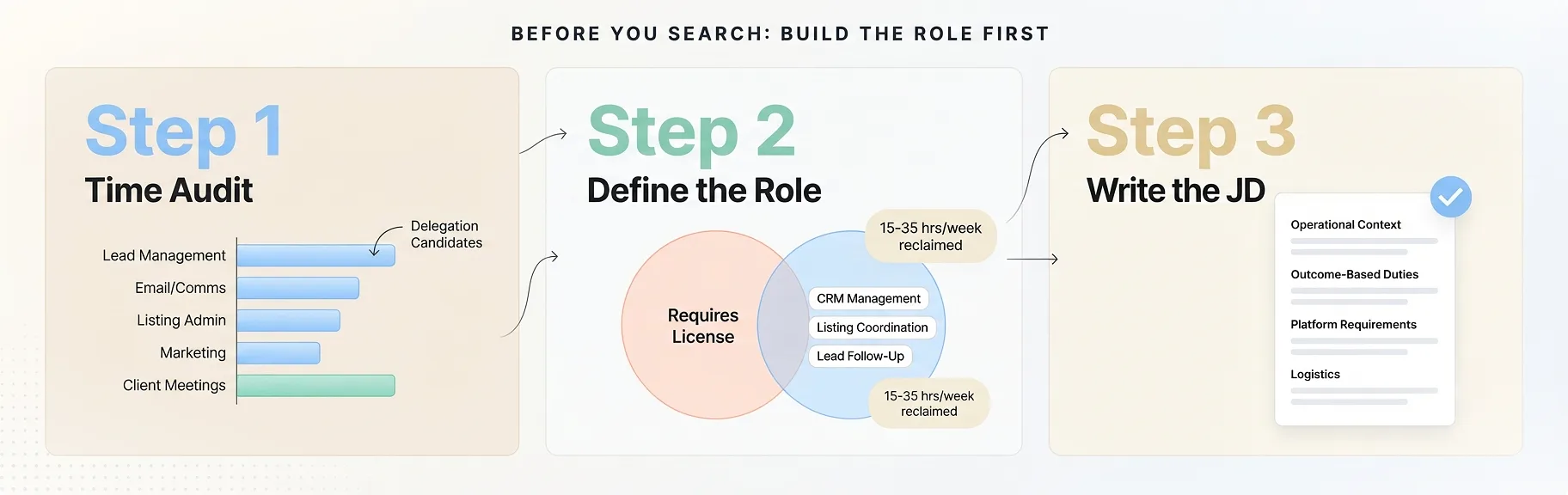
A well-defined REVA role begins with a time audit. Before writing a single line of a job description, document where your time actually goes each week.
Here is how to do it:
- Track every task you perform for five consecutive business days using a simple time log: task name, time started, time finished, and category (lead management, administrative, marketing, transactions, client-facing).
- After five days, categorize each logged task as either “requires a license” or “does not require a license.”
- Everything in the “does not require a license” column is a delegation candidate.
- Sort delegation candidates by weekly time cost, from highest to lowest.
- Your top five entries by time cost become the foundation of your VA role description.
This approach gives you a role built on actual operational data, not assumptions. The result is a job description that attracts candidates with the right skill set and gives you a clear baseline for measuring performance from day one.
What Your Role Definition Should Include
Before you begin any outreach or posting, your role definition document should answer these questions:
- What are the three to five primary functional areas this person will own?
- Which platforms and tools will they use daily?
- What does a “completed task” look like for each function?
- What hours or time zone coverage does the role require?
- What is the minimum acceptable response time for client-facing communications?
- What are the non-negotiable skills versus the trainable skills?
Agents who complete this exercise typically discover they need a REVA focused primarily on one or two functional areas – such as lead management and CRM operations, or listing coordination and marketing – rather than a generalist covering ten functions at low quality.
Step 2: Write a Job Description That Attracts the Right Candidates
A vague job description produces a vague candidate pool. Specificity is your most effective filtering tool at this stage, and it costs nothing.
The Four Sections Every REVA Job Description Needs
Section 1: The Operational Context Describe your business in concrete terms. How many active listings do you manage? How many leads enter your pipeline monthly? What CRM do you use? What transaction volume did you close last year? A candidate who sees specific numbers self-selects more accurately than one who reads generic descriptions.
Section 2: Core Responsibilities (Written as Outcomes, Not Activities) Instead of writing “manage the CRM,” write “maintain 100% data accuracy across all active pipeline contacts in Follow Up Boss, including daily lead tagging, stage updates, and drip sequence enrollment within two hours of lead entry.”
Instead of “help with marketing,” write “publish four social media posts per week across Instagram and Facebook using a pre-approved content calendar, respond to all comments within 24 hours, and compile a weekly engagement report.”
Outcome-based descriptions attract candidates who think in terms of results, which is exactly what you need.
Section 3: Required Skills and Platform Proficiencies List the specific platforms you use. Do not write “experience with real estate software.” Write “proficiency in Follow Up Boss or KvCORE required; Dotloop or Skyslope experience strongly preferred; Canva and Google Workspace required.”
Section 4: Logistics and Work Arrangement Specify hours, time zone expectations, communication response standards, and whether the role is part-time or full-time. Ambiguity here generates candidate questions that waste time on both sides.
Step 3: Choose the Right Hiring Channel
Where you source your real estate virtual assistant directly affects the quality of your candidate pool, your cost structure, and the time investment required to fill the role. Each channel has distinct trade-offs.
Primary Hiring Channels Compared
| Hiring Channel | Best For | Cost Range | Vetting Responsibility | Speed to Hire |
|---|---|---|---|---|
| Specialized RE VA Agencies | Agents wanting pre-vetted, RE-trained candidates | $1,500-$3,500+/month | Agency handles vetting | Fast (days to 2 weeks) |
| OnlineJobs.ph / VirtualStaff.ph | Cost-conscious agents comfortable managing the hire | $4-$12/hour | Buyer handles all vetting | Moderate (1-3 weeks) |
| Upwork | Flexible project-based or part-time needs | $10-$25/hour | Buyer handles vetting | Fast, variable quality |
| MyOutDesk | Full-time, real estate-specific VA support | ~$1,988+/month | Agency handles vetting | Moderate |
| Referrals from other agents | Highest-trust hires with proven track records | Variable | Referral source pre-vets | Slow but high quality |
According to Stealth Agents’ 2025 research, a U.S.-based real estate VA averages $24.40 per hour, while equivalently skilled offshore candidates typically cost $7-$12 per hour – a cost difference that compounds significantly at full-time volume.
Which Channel Fits Your Situation?
Choose a specialized agency if: You are hiring your first VA, you want speed and reduced risk, and you are willing to pay a premium for pre-screened candidates with real estate-specific training.
Choose a direct-hire platform if: You have hired VAs before, you have the time to conduct thorough vetting, and cost efficiency is a priority.
Choose a referral if: You know another agent whose VA has expressed interest in additional clients or whose VA network you can access. This is the lowest-risk option when available.
Step 4: Screen Candidates with a Skills-First Process
The interview should confirm what the screening process already established. Most agents do this in reverse: they interview first and then realize they cannot assess actual skill level from a conversation alone.
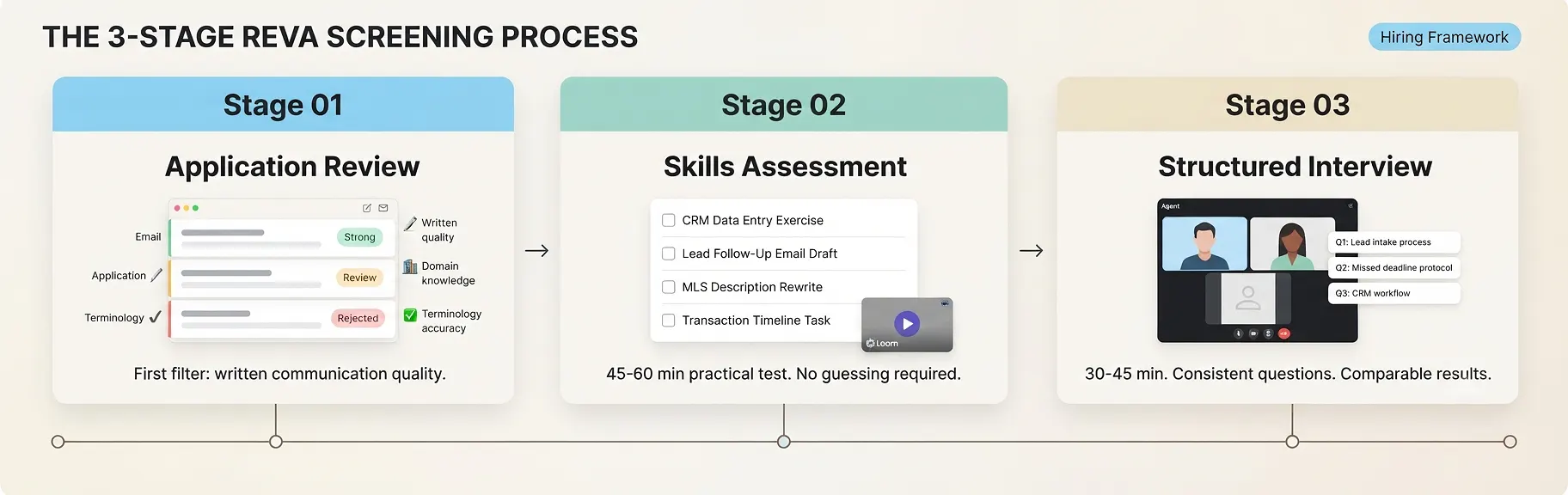
The Three-Stage Screening Process
Stage 1: Application Review Evaluate written communication quality immediately. How the candidate writes their application is a direct proxy for how they will write emails to your clients and leads. Look for:
- Specificity in describing past real estate experience
- Accurate use of real estate terminology
- Evidence of CRM and transaction management platform familiarity
- Clear sentence structure and professional tone
Immediately remove any candidate whose written communication does not meet the standard you would want representing your brand.
Stage 2: Asynchronous Skills Assessment Before any live interview, send shortlisted candidates a practical assessment. This should take 45-60 minutes and include tasks directly relevant to your actual workflow. Effective assessment tasks include:
- A sample CRM data entry exercise using a mock contact record
- A lead follow-up email draft based on a provided scenario
- An MLS listing description rewrite for clarity and SEO quality
- A transaction timeline organization task: given a set of dates and milestones, create a deadline calendar
- A brief screen-share video (via Loom) showing how they navigate a CRM dashboard
The assessment response tells you more about the candidate than an hour-long interview. Candidates who submit high-quality assessment work on time, without excuses, are demonstrating exactly the work ethic and attention to detail your operation requires.
Stage 3: Structured Interview For candidates who pass the assessment, conduct a structured 30-45 minute video interview. Use consistent questions across all candidates so you can make direct comparisons.
High-Value Interview Questions for REVA Candidates
Use these questions to evaluate depth of real estate domain knowledge and operational thinking:
- “Walk me through how you would handle a new inbound lead from a Zillow inquiry from initial contact through CRM entry and first follow-up sequence enrollment.”
- “A contingency deadline is 48 hours away and you cannot reach the buyer’s lender. What do you do, and who do you contact?”
- “Describe the last CRM you worked in extensively. How did you organize contacts, and what was your process for keeping pipeline stages accurate?”
- “If an agent asks you to ‘manage their social media,’ what specific questions do you ask before starting?”
- “How do you prioritize competing urgent tasks when multiple deadlines are approaching simultaneously?”
- “Have you used Dotloop, Skyslope, or a comparable transaction management platform? Describe a specific workflow you managed within it.”
Strong candidates answer with process specificity. Weak candidates answer with vague generalities. That distinction is immediately apparent in responses.
Step 5: Evaluate and Compare Shortlisted Candidates
After completing stages one through three, use a standardized scorecard to compare candidates objectively. Subjective impressions from interviews are unreliable hiring signals. A structured scoring framework removes bias and creates a defensible hiring decision.
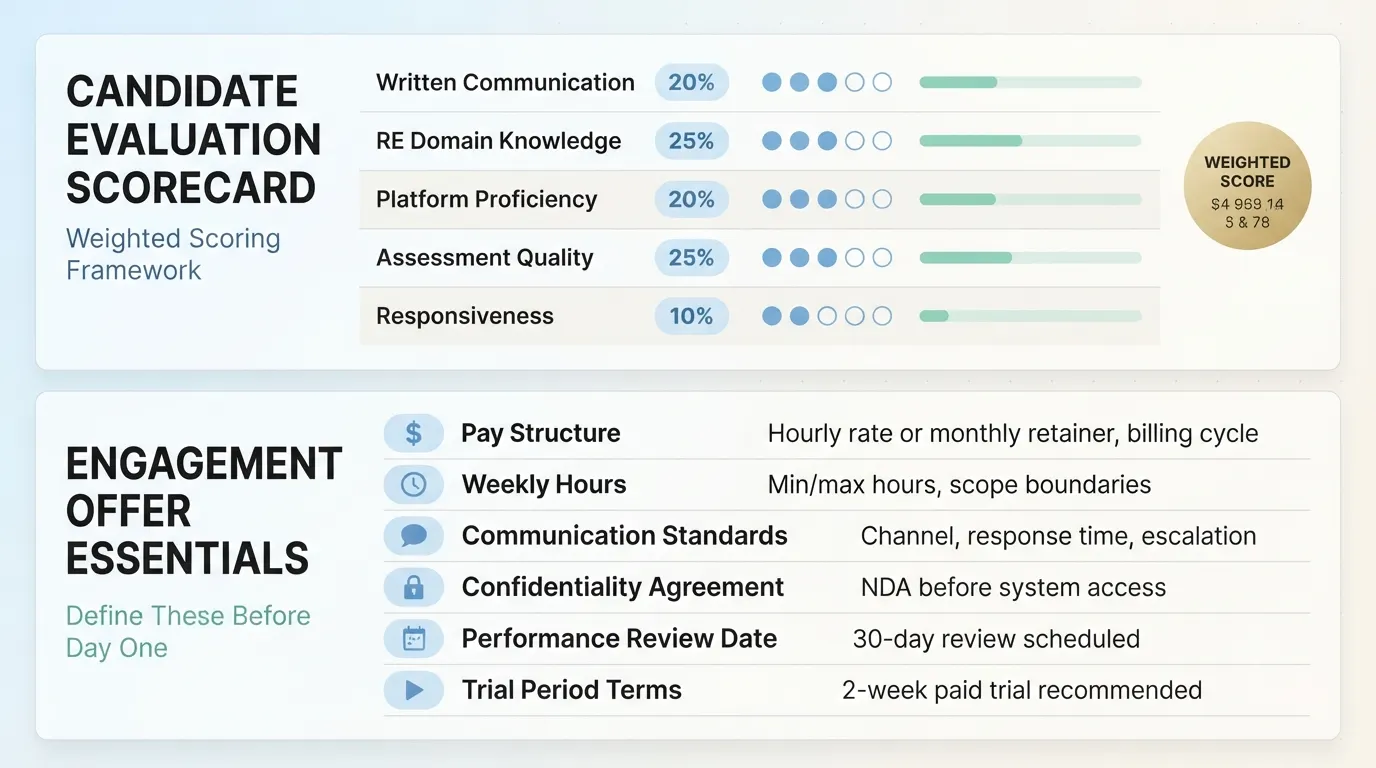
REVA Candidate Evaluation Scorecard
| Evaluation Criteria | Weight | Rating Scale |
|---|---|---|
| Written communication quality | 20% | 1-5 |
| Real estate domain knowledge | 25% | 1-5 |
| Platform and CRM proficiency | 20% | 1-5 |
| Assessment task quality and accuracy | 25% | 1-5 |
| Responsiveness and professionalism | 10% | 1-5 |
Multiply each rating by its weight to calculate a weighted score. The candidate with the highest weighted total is your strongest objective hire. Use this alongside your interview impressions to make the final decision.
Red Flags to Watch For During Screening
Be cautious of candidates who:
- Cannot name specific real estate platforms or tools by name
- Use vague language like “I’m a fast learner” as a substitute for demonstrated experience
- Submit the assessment test late without proactive communication
- Cannot describe a specific process; only outcomes (“I managed everything efficiently”)
- Have never worked with a real estate agent, broker, or property management company
- Request unusually high rates relative to demonstrated experience
- Are unavailable during your required working hours
Step 6: Structure the Offer and Engagement Terms
Once you have selected your candidate, get the terms of engagement documented clearly before work begins. Ambiguity in the working arrangement creates disputes and misaligned expectations that derail otherwise strong VA relationships.
What Your Offer and Agreement Should Cover
- Hourly rate or monthly retainer: Be explicit about the pay structure, billing cycle, and payment method.
- Expected weekly hours: Specify the minimum and maximum hours per week to prevent scope creep or underutilization.
- Communication standards: Define the primary communication channel, expected response times during working hours, and escalation protocol for urgent matters.
- Confidentiality expectations: Your VA will have access to client data, CRM records, and potentially financial information. A confidentiality or non-disclosure agreement is standard practice, not an overreach.
- Performance review cadence: Establish that a 30-day review will occur to assess onboarding progress and alignment with expectations.
- Trial period terms: Many successful VA engagements begin with a two-week paid trial at reduced scope. This benefits both parties: the agent evaluates real-world performance, and the VA understands the workflow before full responsibility transfers.
Step 7: Build Your Onboarding Infrastructure Before Day One
This is the step that most agents skip entirely, and it is the most direct cause of failed VA hires. According to data from Trainual, teams with strong onboarding see 82% higher new-hire retention and 70% greater new-hire productivity compared to those with weak onboarding processes.
You cannot delegate what you have not documented. Before your VA’s first day, prepare:
The Pre-Day-One Onboarding Checklist
Access and Accounts:
- Create CRM user account with appropriate permission levels
- Set up email access or shared inbox access (as applicable)
- Grant calendar access and establish scheduling conventions
- Provide MLS login credentials (if applicable and compliant with your board’s rules)
- Set up communication channel access: Slack, Google Chat, or your preferred platform
- Share transaction management platform access
Documentation:
- Record Loom walkthrough videos for each primary task area (5-10 minutes each)
- Write step-by-step SOPs for the top three recurring tasks in written format
- Create a contacts directory: key vendors, lenders, escrow officers, inspectors
- Document your communication style preferences and brand voice guidelines
- Provide a glossary of your business-specific terminology and abbreviations
Expectations:
- Share a written first-week task list with specific deliverables and deadlines
- Explain what “done” means for each task category
- Set the 30-day performance review date on the calendar
Understanding exactly what does a real estate virtual assistant do in their first 30 days is critical to structuring an onboarding plan that accelerates their productivity curve rather than extending it.
Step 8: Execute a Structured 30-Day Ramp Protocol
The 30-day ramp period is not a probationary limbo. It is a structured acceleration program. How you manage this period determines whether your VA reaches full productivity in month two or month six.
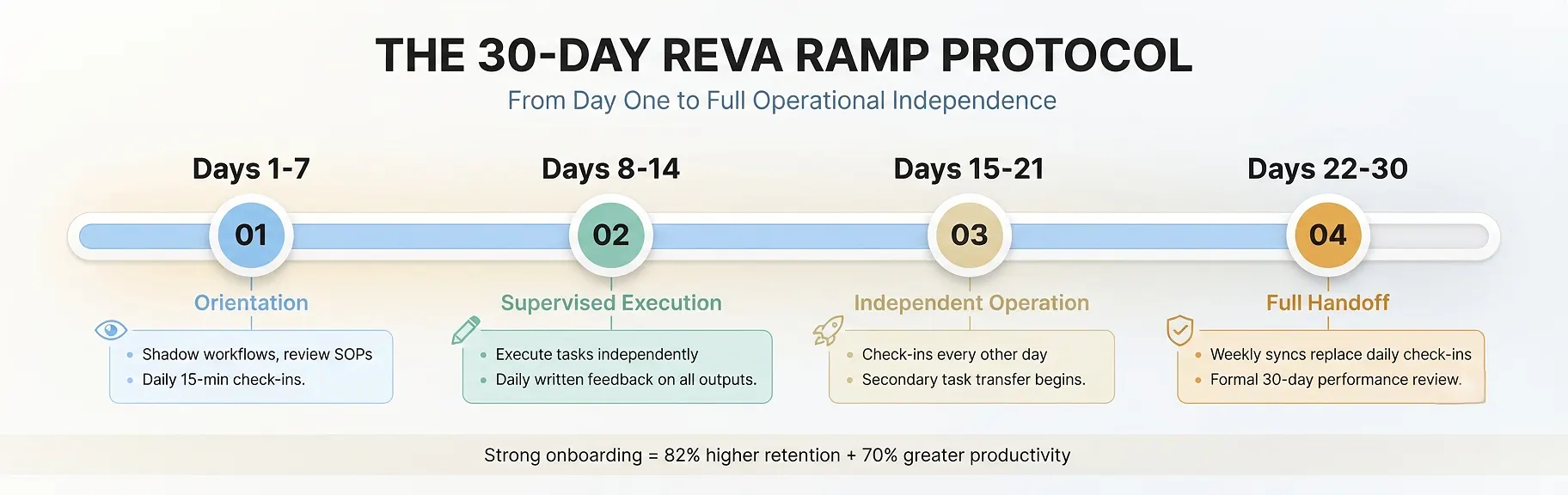
The 30-Day Ramp Framework
Days 1-7: Orientation and Observation The VA shadows existing workflows, reviews all SOPs, watches all Loom recordings, and completes their first assigned tasks with close feedback. Expect questions. Build in a daily 15-minute check-in during this week.
Days 8-14: Supervised Execution The VA executes primary tasks independently while you review outputs daily. Provide written feedback on every deliverable. Correct errors immediately and explain the reasoning – not just the correction.
Days 15-21: Independent Execution with Check-Ins The VA operates independently on established tasks. Shift daily check-ins to every other day. Begin transferring secondary tasks. Monitor output quality without micromanaging the process.
Days 22-30: Full Operational Handoff The VA owns their functional areas. Weekly check-ins replace daily touchpoints. Conduct a formal 30-day review covering output quality, task completion rate, communication responsiveness, and alignment with expectations.
Common Mistakes Agents Make When Hiring a Real Estate VA
Even with good intentions, agents consistently repeat the same hiring errors. Recognizing these patterns before you encounter them saves significant time, money, and frustration.
Mistake 1: Hiring for Personality Instead of Process Competency
A candidate who is warm, enthusiastic, and easy to talk with is not necessarily a candidate who can manage a complex CRM pipeline under deadline pressure. Likability is not a job skill. Prioritize demonstrated competency over personal rapport in your evaluation.
Mistake 2: Hiring Before the Role Is Defined
When you hire without a clear role definition, you get a VA performing whatever seems most urgent on any given day. The result is inconsistency, task overlap, and a VA who cannot grow because they have no defined domain to master.
Mistake 3: Skipping the Skills Assessment
Resumes and interviews are weak predictors of actual job performance. A practical skills assessment is the only reliable signal of how a candidate performs on real tasks under real conditions. Skipping this step is the fastest path to a hiring mistake.
Mistake 4: Choosing the Cheapest Option Without Evaluating Total Cost
An offshore VA at $5 per hour who requires constant supervision, produces low-quality work, and churns after 90 days costs far more than a $12 per hour candidate who onboards cleanly and delivers consistent output. Evaluate cost per quality output, not cost per hour.
Mistake 5: Delegating Without Documentation
“Just figure it out” is not an onboarding strategy. Without written SOPs and video walkthroughs, your VA is guessing at your preferences and standards for every task. The output reflects that guesswork.
Mistake 6: Not Setting KPIs from Day One
If you cannot measure it, you cannot manage it. Define measurable performance indicators for every primary task area before work begins. Response time, task completion rate, CRM accuracy rate, and lead follow-up velocity are all quantifiable metrics that give you an objective basis for performance conversations.
Expert Tips for a Successful Real Estate VA Hire
Beyond the formal process, these field-tested practices separate high-performing VA relationships from mediocre ones.
Record your first SOP as you perform the task. Use Loom to capture your screen while you execute each recurring workflow once. This creates documentation in the same time it takes to do the task normally – and the video is more useful than any written guide because the VA can watch your actual screen, your mouse movements, and your decision logic.
Start with the task that causes you the most daily friction. The highest-leverage first delegation is not necessarily the most time-consuming one. It is the one that most consistently interrupts your peak-performance work. Identify that task and make it the VA’s first ownership area.
Create a shared vocabulary document. Every real estate business has proprietary terminology: your specific CRM stage names, your lead category labels, your internal abbreviations. A simple Google Doc glossary that the VA can reference independently reduces the volume of clarifying questions dramatically.
Schedule a weekly 30-minute sync indefinitely. Even after the onboarding period, a recurring weekly alignment meeting maintains shared awareness of pipeline priorities, prevents communication drift, and gives both parties a regular forum to surface issues before they become problems.
Build a feedback loop, not a correction cycle. When your VA makes a mistake, provide the correction in writing with the context of why the correct approach matters. This converts individual corrections into cumulative process knowledge.
Hiring Channel Deep-Dive: Where to Find Qualified Candidates
When you are ready to post your role or begin outreach, these channels deliver the most reliable results for real estate-specific VA hires.
Specialized Real Estate VA Agencies
Agencies such as MyOutDesk and similar real estate-focused VA providers pre-screen candidates for industry knowledge, conduct skills assessments, and handle replacement guarantees when placements do not perform. The premium pricing reflects reduced hiring risk and faster time-to-productivity for agents who do not have the bandwidth to manage an extensive screening process themselves.
Direct-Hire Platforms
OnlineJobs.ph and VirtualStaff.ph connect agents directly with Filipino virtual assistants – a talent pool that combines strong English communication skills, high real estate industry familiarity, and cost-effective rates. According to Stealth Agents’ platform comparison research, direct hires via these platforms typically cost $4-$8 per hour compared to $10-$15 per hour through managed agencies. The trade-off is that all vetting, contracting, and payroll management falls on the hiring agent.
Freelance Platforms
Upwork provides access to a broad international candidate pool with built-in time tracking, payment protection, and review history. The platform works well for part-time or project-based arrangements, particularly for agents who want to test a VA relationship at lower commitment before moving to a longer-term engagement.
Professional Referrals
The highest-quality hires often come through referrals from agents in your network whose VA is open to additional clients or who has a recommendation from their own network. Ask in your brokerage, your mastermind group, or your professional associations. The pre-existing trust signal from a respected referral source eliminates much of the uncertainty inherent in cold candidate evaluation.
The National Association of Realtors’ research on technology adoption consistently shows that agents who build systematic operational support structures outperform those who work without them. Hiring the right VA is one of the most direct ways to build that structure.
How to Measure ROI After You Hire a Real Estate VA
Hiring a VA is an investment. Like any investment, it requires measurable return tracking to justify and optimize.
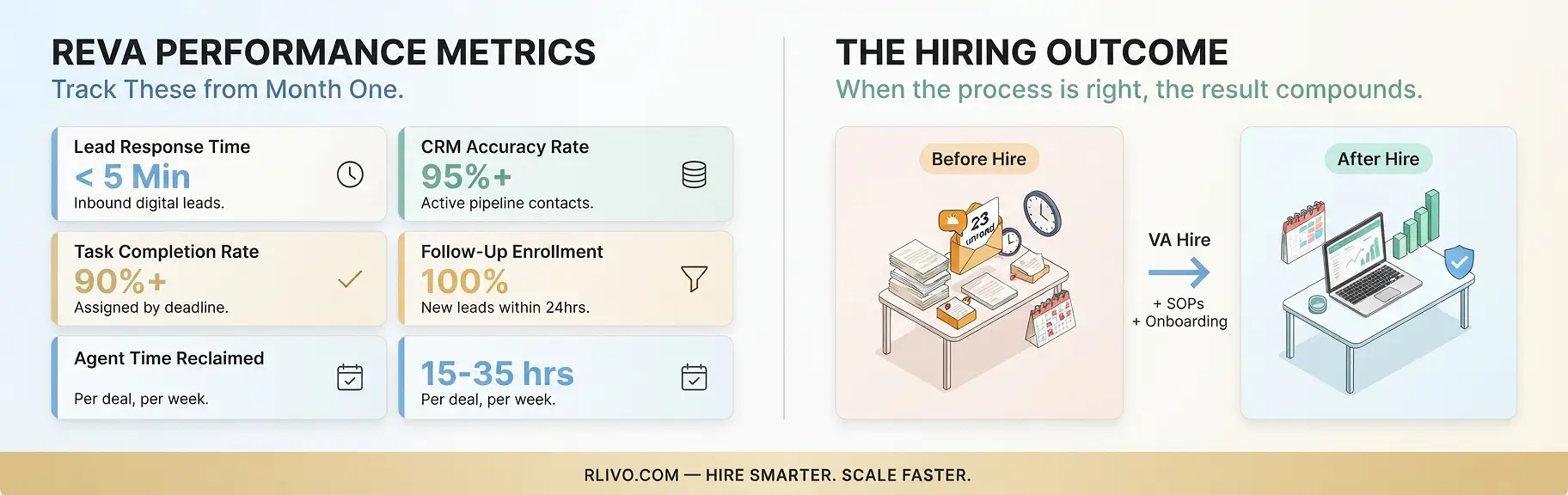
Key Performance Indicators to Track from Month One
| KPI | What It Measures | Target Benchmark |
|---|---|---|
| Lead response time | Hours between lead entry and first contact attempt | Under 5 minutes for inbound digital leads |
| CRM accuracy rate | Percentage of contacts with complete, current records | 95%+ |
| Task completion rate | Percentage of assigned tasks completed by deadline | 90%+ |
| Follow-up sequence enrollment | Percentage of new leads enrolled in drip sequence within 24 hours | 100% |
| Transaction deadline compliance | Percentage of contractual deadlines met without agent intervention | 100% |
| Agent time reclaimed | Hours per week freed from delegated tasks | Track against pre-hire baseline |
Set a 90-day review date when the engagement begins. At 90 days, evaluate whether the VA has met the KPI benchmarks, whether the scope has expanded appropriately, and whether the engagement structure should be adjusted (hours, role focus, or compensation).
The agent time reclaimed metric is the most telling ROI indicator. If you were spending 20 hours per week on delegable tasks before the hire and you are now spending 5 hours on those same categories, that 15-hour weekly recapture is yours to direct toward revenue-generating activities.
FAQs: How to Hire a Real Estate Virtual Assistant
How do I know when I am ready to hire a real estate virtual assistant?
You are ready when you can identify at least 10-15 hours of weekly tasks that do not require your license and are consistently taking time away from client-facing or revenue-generating activities. If you are spending more than two hours daily on email management, CRM updates, listing administration, or social media, a REVA will immediately reclaim productive capacity.
How to hire a real estate virtual assistant if I have never worked with one before?
Start with a narrow, well-defined scope covering one to two functional areas where you have clear SOPs and measurable outputs. A first-time agent VA relationship works best when the initial task set is small enough to onboard cleanly, delivers immediate measurable value, and builds the working rhythm before expanding scope.
What is the difference between hiring a VA independently versus through an agency?
Independent hires through platforms like OnlineJobs.ph or Upwork give you direct control over candidate selection, compensation, and the working relationship. Agency hires provide pre-screened candidates with real estate-specific training, replacement guarantees, and reduced initial risk – at a higher cost. First-time hirers often benefit from the agency route to establish a baseline for what good VA performance looks like.
How long does onboarding typically take for a real estate VA?
Expect a 2-4 week ramp period before a new VA reaches consistent independent output quality. The ramp period is shorter for candidates with deep prior real estate experience and longer for those transitioning from general VA roles. A structured onboarding protocol with written SOPs and Loom video walkthroughs significantly compresses this timeline.
What should I pay a real estate virtual assistant?
Rates vary significantly by geography, experience level, and engagement model. Offshore real estate VAs typically range from $7-$12 per hour for direct hires. U.S.-based generalist VAs average around $24 per hour according to current market data. Specialized agency placements run $1,500-$3,500+ per month depending on hours and scope. Evaluate cost per quality output rather than hourly rate in isolation.
What are the most important skills to screen for when hiring a real estate virtual assistant?
Prioritize: real estate CRM proficiency (Follow Up Boss, KvCORE, or similar), transaction management platform experience (Dotloop, Skyslope), strong written communication, MLS familiarity, and demonstrated ability to follow multi-step processes independently. Secondary skills such as Canva proficiency, email marketing platform experience, and social media management are trainable; core real estate operational knowledge is not easily trained from scratch.
How do I protect my client data when working with a VA?
Use a confidentiality agreement before granting any system access. Create CRM user accounts with role-specific permission settings that limit access to only what is necessary for the VA’s function. Use a password manager with shared access (rather than sharing login credentials directly) and audit access logs periodically. These are standard data hygiene practices for any remote working relationship.
The Process is the Product
Most agents who have struggled with VA hires did not fail because good candidates do not exist. They failed because they treated hiring as an event rather than a process.
Learning how to hire a real estate virtual assistant correctly means building the infrastructure before you search: the role definition, the screening framework, the onboarding documentation, and the performance measurement system. When those elements are in place, the hire itself almost always succeeds. When they are absent, even the best candidate in the world struggles to deliver consistent value.
The agents who build operations that scale beyond their individual capacity are not working harder than everyone else. They have built better systems – and hired the right people to run them.
When you are ready to build that operation without the trial-and-error cycle, who are trained, screened, and ready to deliver from day one.